Latest News
Five Minutes With: Anne de Charmant
In our short series Five Minutes With, we’ve been shining a light on the people who help bring Meadow Arts’ vision to life. From dedicated team members to our brilliant Trustees and the artists we work with, we’re taking a closer look at the individuals who make everything we do possible.
In this episode, Clare Purcell, Executive Director at Meadow Arts, speaks with her colleague Anne de Charmant, Founder, Artistic Director and Curator, to reflect on an exciting moment for the organisation, as Meadow Arts celebrates its 25th anniversary and presents BorderLands (15 May – 31 August) at Hay Castle.
Fundamentally I believe that contemporary art is the best tool in the box to examine the times we are living in. Artists have always been on the forefront of the trends that agitate public or societal issues, they are like sentinels on the side of the road of time. Even when artists express their most personal and intimate selves, they give us nourishment and deep insights.
Anne de Charmant
Anne founded Meadow Arts in 2001 with a simple but radical observation: that rural communities across the West Midlands had almost no access to high-quality contemporary visual art. Moving to rural Shropshire, she responded by founding a non-venue-based charity that collaborates with partners to bring curated, high-quality contemporary art to underserved areas. As Meadow Arts celebrates its 25th anniversary this year, that founding vision has matured, making the charity one of the most distinctive and resilient arts organisations in the region.
Today, Meadow Arts is known for innovation and responsiveness as well as the quality and diversity of its programmes. Anne’s favourite role is introducing artists to a site or community and inviting them to respond as they choose; stepping back she watches the creative cogs start to turn.
Clare: The challenges you addressed when founding Meadow Arts were structural and cultural – without a building, a permanent gallery, or the institutional infrastructure that urban arts organisations take for granted, you had to reimagine how contemporary art could reach new audiences. How did you achieve that?
Anne: In a way it was a very organic process, responding to opportunities and taking it one step at a time to slowly build something from scratch. On the other hand it derived from years of observation (as an arts writer and journalist) about how to propose and produce contemporary art away from the mainstream art scene. My personal interest (and delight!) for the landscape played a big part in setting up Meadow Arts. When I moved to the UK and then to the Welsh Border region, I was struck by the huge cultural impact the countryside and the landscape have in this country’s common imagination. For example, I believe the national passion for gardens derives from the fascination with the landscape. They are one of the expressions of the nature-culture correlation. This is not the case in the rest of Europe. In France for example “la campagne” is a bit of a non-space. So I was a bit shocked that there were so few opportunities to see and produce high-quality contemporary art. I had also looked at different models of showing art in the landscape in different countries and in the UK. At the time the most common model was the sculpture park or sculpture trail, but I found that these were very static and mostly concerned huge sculptures. I thought it would be more interesting to produce programmes that were temporary and curated, to tell a story.
In 2001 I was organising exhibitions in a lovely place called Burford House, just on the border of Shropshire, Herefordshire and Worcestershire. It was clear to me from the very beginning that working in partnership with another site was the way forward as starting a contemporary art space from scratch on its own had very little chance of attracting enough visitors given our rural geographic position.
One day someone from the Arts Council left a business card encouraging me to talk to them. This was the beginning of a crucial relationship that went beyond pure finding. It was very lucky that the beginnings of Meadow Arts coincided with a period of plenty in the state funding of the arts – that period now seems almost surreal. The first tranche of Arts Council Funding allowed an experimentation in how to show art in the environment; we planted a system of hedges that formed a series of rooms in a fallow field sowed as a wildflower meadow – hence the name of Meadow Gallery as it was known then. With the promise of funding from the Arts Council the time came to build up a more formal organisation with its associated business plans, budgets and boards.
Clare: You are known for your bold curatorial ambition – using art to address the defining issues of our time: for example climate change through the prism of water and flooding in Watermark (2023) delivered across multiple venues in Worcester; a city with lived experience of flooding and, BorderLands (2026) which brings together international artists and local communities to interrogate the idea of borders, geographical, cultural and personal, as places of connection, inspired by the Welsh Border region around which Meadow Arts operate. How do you set about framing these projects?
Anne: From the very beginning, it felt right that Meadow Arts’ programmes should be defined within the context of the natural environment, landscape and the countryside, with all the history and complexities that this entails. This broad curatorial framework has proved to be an amazing prism for exploring different issues that preoccupy contemporary society and it means we are able to respond meaningfully to a changing world. Together with artists we continue to tell hidden stories, ask difficult questions, pick up strands and signs. We always try to encourage conversations, question preconceptions. Today, Meadow is incredibly well placed to continue working with artists and communities to look at current problems such as the changing climate, food and soil, health and well-being etc.
Fundamentally I believe that contemporary art is the best tool in the box to examine the times we are living in. Artists have always been on the forefront of the trends that agitate public or societal issues, they are like sentinels on the side of the road of time. Even when artists express their most personal and intimate selves, they give us nourishment and deep insights.
Clare: What makes your work exceptional is not just its scale or ambition, but its integrity. To date, you have worked with over 150 artists and curated dozens of exhibitions and projects with a huge variety of partners. You are known for an open-minded, artist-led approach, inviting artists to respond to place, landscape and theme without imposing outcomes. Yinka Shonibare CBE captured it: “What’s great about Meadow Arts is their openness to ideas, I was given the freedom to do what I wanted”. That freedom produces bold, risk-taking work that resonates with audiences who may never have encountered contemporary art before. Can you tell us more about this and what you have discovered by letting artists take the lead?
Anne: Well, yes, I do give artists lots of space when I commission a new work and I’m glad that artists feel like they have lots of freedom, but I have to say that the process is actually quite tightly controlled. There is a lot of steering going on from start to finish, but it has to be sympathetic and creative in itself. To make sure the outcome is the best that can possibly be achieved, takes quite a lot of interventions, the secret is that these must always be light touch and positive.
The most important part of my curatorial approach is in framing the commission. The first decision is to very carefully define the issue or theme we are exploring and then choosing the best artist to explore a particular area or concern, pairing the right artist to any given conceptual framework. For example Hilary Jack is a wonderful artist, but also a climate activist and it made complete sense to ask her to participate in Watermark, a project about water and flooding. She responded with a wonderful artwork that was picked up by other prestigious organisations. The other determining factor is that we give artists the most amazing contexts for them to respond to. Whether it’s a historical building, an object, a landscape or a particular community, it will pretty much automatically send the artist in a direction that will be deeply engaging and rich. And that is where Meadow Arts can really shine as we work with the best partners in the most amazing places. For example, you mentioned Yinka Shonibare, well I was able to bring him a proposal that was pretty irresistible: responding to the 12th century Hereford Cathedral Mappa Mundi. I knew that this would fit beautifully in the area of work he was exploring at the time, both conceptually and aesthetically. Sure enough he was hugely responsive and inspired. This project also implied getting the Cathedral on board, but that’s a story for another day.
Then to make sure a commission stays on track involves a lot of conversations and site or studio visits. It can take a long time to refine a proposal until we are ready for production. Sunday 5 July, after the celebration of the 25th anniversary, an artist whom we commissioned twice, told me “I have made my best work when working with you”. This is the most amazing compliment I’ve been given in my career. This artist also thanked me for pushing him into reworking the commission quite a few times until it was the best work that could be achieved.
Clare: After 25 years, you have demonstrated that geography need not determine cultural access, and that a single founding vision, sustained with passion and openness, can change lives. Where do you hope Meadow Arts will be in five-year’s time?
Anne: Our flexibility and ability to respond to changing circumstances has made us a very resilient organisation; we are adaptable and light on our feet. Similarly we can keep our fingers on the pulse of larger trends and go where the energy is. Today, we are very far from the days of plenty, the cultural sector – and the visual arts in particular – are in dire straits in terms of funding. We have noticed that our partners are all struggling just to keep afloat and that has a direct impact on us. Unfortunately, the time of the big bold exhibitions, when we could show artworks throughout amazing historical buildings, is probably over.
We will have to be much more discerning in the way we operate and adapt how we work. But there are always positive aspects when faced with new constraints. We might want to work more in depth on more impactful collaborations. We might also want to work more with similar organisations throughout the country and even internationally – as we have started doing – while at the same time respond in more rooted ways in our immediate region. Meadow Arts certainly has more to propose and we will continue to have a deep impact, working with communities, partners and of course artists.
Clare: Outside of work you are known for your wonderful homes and bountiful flower-rich gardens, which are a personal extension of your artistic vision. Who would be invited to your garden if you were to host your ideal artist party?
Anne: Thanks, yes I put quite a bit of myself into my home and I love to be surrounded by objects, textiles and art that are meaningful to me as well as beautiful. I’ve been known to curate even a window sill. My father was a collector and I got that bug a long time ago. I’ve been called a “cuhshinista” by my partner for the way I keep rearranging the cushions of the sofas. We are incredibly lucky to live in an old farmhouse in a beautiful valley where we are the temporary custodians of majestic old trees, one of which is a 900 years old oak that has the presence and stature of a cathedral.
I’m very excited by the garden party. I think I’d have a few old masters coming out of the last centuries. I’d like to invite Hubert Robert (1733-1808) a French painter who spent a long time in Italy and painted wonderful landscapes with ruins, real or imagined. He was known to be the happiest of artists, even when imprisoned in the Bastille, he was said to have been great company. He was also an amazing garden designer. I think he’d have a lot to talk about with Claude Lorrain(1600-1682) whom I would love to invite. Known in the UK as just “Claude”, he is the great master of landscapes and I’d love to know what he might think of our beautiful countryside here on the Welsh Border. To complete the conversation about landscape, I’d like to invite Caspar David Friedrich (1774-1840) who could inject a final touch of romanticism.
I’d also like to ask Artemisia Gentileschi (1593 – 1654). I read a biography of hers as a teenager and was stuck by what she went through in a life full of violence and struggles, all of which is reflected in her intense paintings. She managed to become one of the most renowned artists of her time, but was then largely forgotten by centuries of male-dominated art history – until the last decade when there were major exhibitions of her work. It would be great to introduce her to Louise Bourgeois (1911-2010) who was another formidable feminist artist and a fighter, but I have a poor record with her. I interviewed her for a Swiss TV programme when I was just 19 and she made mince-meat out of my naive, gibbering young self. Who knows, we might get on better now. Finally I’d love to invite Anselm Kiefer. Apart from being the only artist who could actually come, it would be so wonderful to try and grasp how his immense universes inhabit him as a person. But there are so so so many other artists I’d invite – let’s make it an open house!
More from Meadow Arts

Golden Valley Molecules at No.1 Station Approach
Earlier this year, Meadow Arts installed a new public artwork by artist Cordelia Cembrowicz in the heart of…

New International Residency Exchange Partnership
Meadow Arts is thrilled to announce a new international partnership with CVAN England, CVAN West Midland with BBK Bayern…
Our Place Golden Valley: Make Your Way Wednesdays
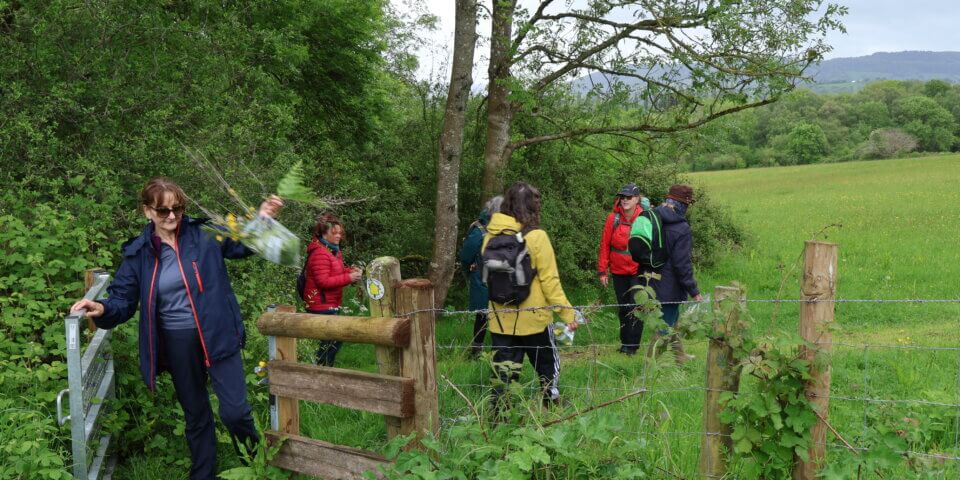
Over the past few weeks, we’ve been walking, looking and making together in the Golden Valley as part…

Celebrating 25 Years of Meadow Arts at Hay Castle
This year marks a very special milestone for Meadow Arts as we celebrate 25 years of bringing contemporary…

Ode to the Midlands Commissioned Artists Announcement
We are delighted to be part of Ode to the Midlands (OttM) with CVAN West Midlands and CVAN…

Our Place Golden Valley: Make Your Way Wednesdays
Make Your Way Wednesdays has got off to a wonderful start, with two guided walks in the Golden…