There is little doubt that climate change is the defining issue of our Age and the image of the flood has become one of the most brutal markers of this reality – along with droughts, wildfires and evermore powerful storms. In collaboration with four Worcester-based organisations, Meadow Arts has chosen to explore climate change through the prism of water and flooding.
Unfolding across Worcester, a city that is no stranger to flooding, Watermark presents a full programme of new commissions, exhibitions, films and talks. It explores how artists today engage with their environmental responsibility, how they express the need to dig deeper into the new reality of the landscape and the global environment, in order to offer perspective and relevance as we enter the era of the Anthropocene*.
Just outside The Hive library, an eye-catching new temporary artwork has been commissioned for Watermark by Meadow Arts. Deluge by artist Hilary Jack comprises two lines of LED text that mimic the relentless scroll of news found on busy urban landmarks and on our screens.
While one line matter-of-factly announces flooding events in Worcester, the UK and around the globe in 2022, the other relays age-old flood narratives and myths from various cultures and distant civilisations. The artwork invites viewers to reflect on the new climate reality that sees almost daily news of flooding. It also aims to demonstrate the deep cultural resonance of age-old myths that have informed cultures the world over, including our own, for thousands of years.
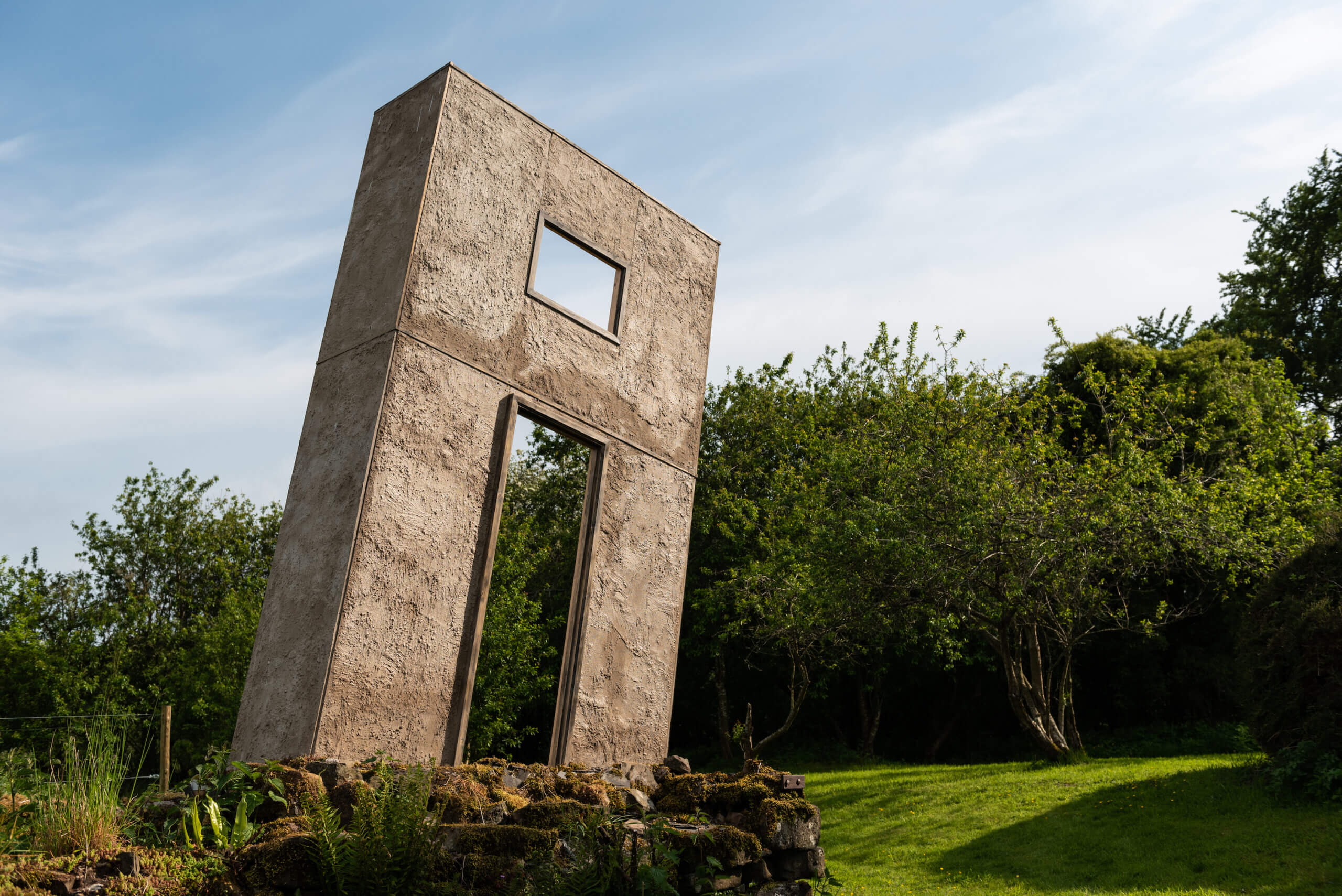
On the landscaped terraces of the Univerity of Worcester’ City Campus, Daniel Pryde Jarman’s two installations Flood and Potemkin seems unstable and precarious. They were inspired by the artist’s research into a US Army training base in the Mojave Californian desert, where replicas of an insurgent’s village were affected by a huge flash flood. In the aftermath, the structures were destabilised, creating a dizzying and unsettling landscape.
At Worcester City Art Gallery & Museum the Watermark presentation shows drawings, watercolours, photography, film and sculpture to illustrate how art, and in particular representations of landscape, necessarily mutate as we enter the new geological era of the Anthropocene*.
Tania Kovats is known for having chosen water as the main subject of her work, exploring its shifting forms and the power it holds in our consciousness. Emma Critchley goes one step further; she has specialised in photographing and filming the underwater environment for her wide-ranging investigations, from territorial politics to the most essential responses of our immersed bodies. With her ‘water maps’ Naiza Khan also focuses on territory and intimate interactions. For her part, Sally Payen has chosen to communicate the terrifying reality of the melting of glaciers and the ice caps through the chemistry involved in the phenomenon.
In her film Force Majeure, Gabriella Hirst questions traditional landscape art by revealing the gap between an event and its representation, as well as the futile ambition to capture vast phenomena within a small rectangular frame. Beyond this, Force Majeure could be seen as a manifesto about the shifting position of the artists as we enter the era of The Anthropocene.
Right in the city centre, in the de-consecrated church of Saint Swithun, three films enliven the remarkable and newly restored interior. Emma Critchley’s Frontier evokes an uncertain watery landscape that could be the aftermath of a global catastrophe or the gigantic machinations of an unknown agent. Simon Faithfull, with his inimitable dry wittiness, describes in Going Nowhere 1.5 the all-too often doomed human actions against a superior force. Unfolding to the slow rhythm of a lighthouse beam, Suky Best’s The Sea House is both shocking and mesmerising, and illustrates the contradiction of unease and fascination we often feel when confronted by floods.
* Scientists increasingly believe the geological age of the Holocene is now over and they have given the name Anthropocene to its replacement, a move that recognises humans as planetary influencers for the first time. The date for this major change is set just after the second world war, when the world embarked on a massive economic and industrial expansion known as the “great acceleration”. This not only began to fundamentally change the Earth’s geology through the minerals we mined, the gases we released (fossil fuels, radioactive material) or the billions of tons of concrete we used, but ultimately had the consequences we now know on the climate.
Join us for a series of talks with many of the artists throughout the exhibition, presented in partnership with the University of Worcester’s Fine Art department. Find out more here.


Watermark takes place across multiple venues in Worcester. Information below.
All venues are free entry.
Open: Monday – Saturday: 10.30am-4.30pm. Sunday & Bank Holidays: Closed.
Carolyn Black until 28 February 2023.
Open: Monday – Sunday: 8.30am – 10pm
Open: See the St Swithun’s website for details.
City Campus,
Castle Street,
Worcester WR1 3AS
Getting there
Open: Accessible 24 hours a day. Wheelchair accessible.
Open: Wednesday – Friday, 12-5pm
Lead image: Daniel Pryde-Jarman, Potemkin, 2021. Wood, plywood, paint, render, scrim, varnish, wax. Photo: Oliver Cameron-Swan.
Featured Artists

Naiza Khan
Born 1968 Bahawalpur, Pakistan Lives and works in Karachi, Pakistan and London, United Kingdom In a practice spanning more than…

Emma Critchley
Emma Critchley is an artist who uses a combination of photography, film, sound and installation to continually explore…

Simon Faithfull
My practice has been described as an attempt to understand and explore the planet as a sculptural object…

Carolyn Black
Carolyn Black’s work focuses on her research into the River Severn. She explores notions of fluctuations and erosion…


Gabriella Hirst
Gabriella Hirst (she/her) is an artist. She was born and grew up on Cammeraygal land (Australia) and is…

Daniel Pryde-Jarman
Daniel Pryde-Jarman is an artist and curator whose research interests include institutional critique, the politics of display, and…

Sally Payen
Born in Oxford UK. Payen attended Brighton Polytechnic (now Brighton University) for her painting degree, she attended the…

Tania Kovats
Tania Kovats makes drawings, sculpture, installations and large-scale time-based projects that explore our experience and understanding of the…

Hilary Jack
Hilary Jack exhibited in Watermark (2023), Pershore Abbey (2023) and BorderLands (2026). Hilary Jack works across media in…
Featured Artworks

Untitled (Graphite putty rubbings and drawings), Carolyn Black


Potemkin, Daniel Pryde-Jarman


Related Events
