Latest News
Five Minutes With: Delaine Le Bas
In our short series Five Minutes With, we’ve been shining a light on the people who help bring Meadow Arts’ vision to life. From dedicated team members to our brilliant Trustees and the artists we work with, we’re taking a closer look at the individuals who make everything we do possible.
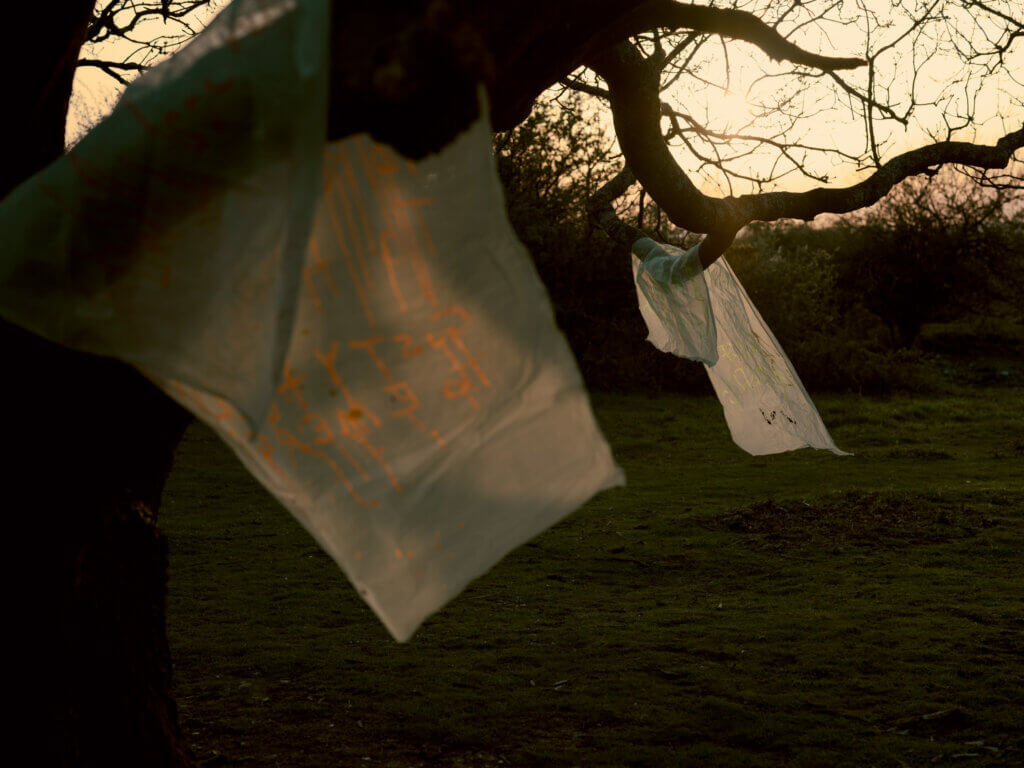
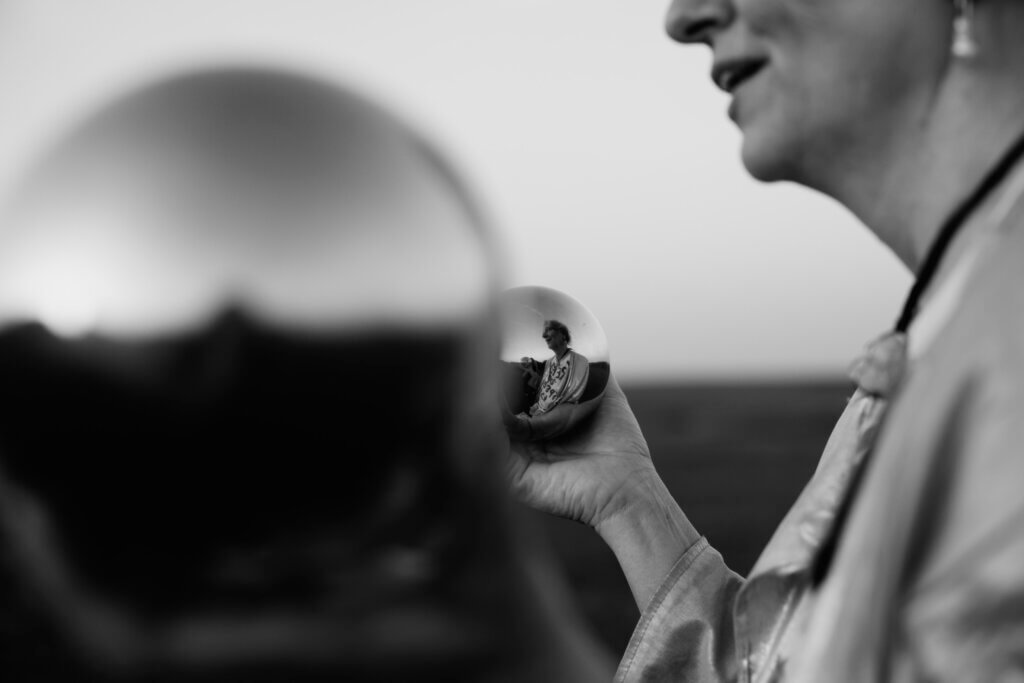
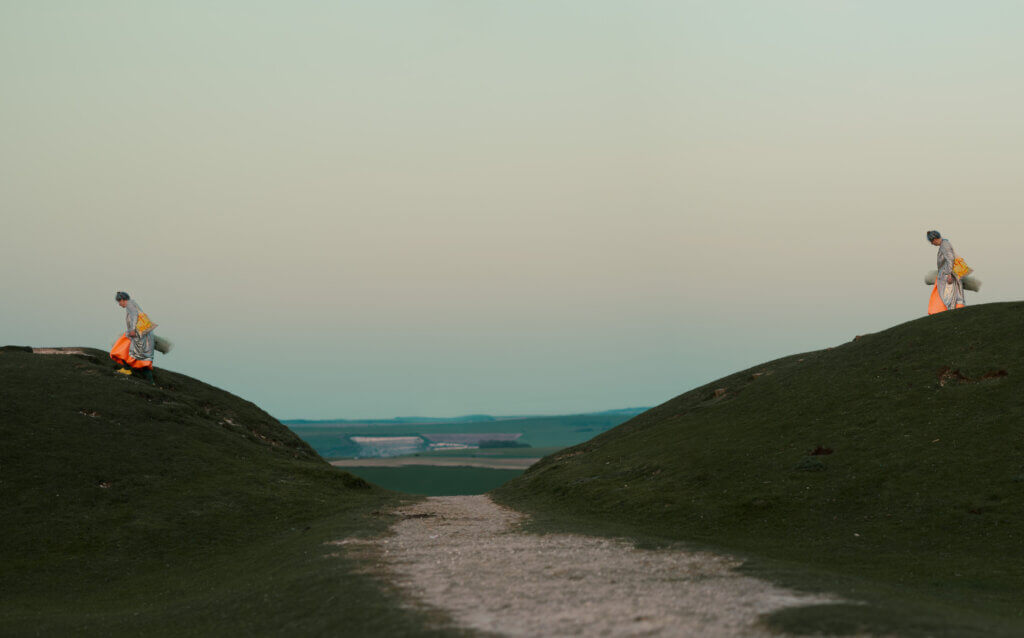
Ahead of the opening on 15 May, Clare Purcell, Executive Director for Meadow Arts, recently joined photographer Finn Beales at Cissbury Ring to capture BorderLands artists, Delaine le Bas, on International Roma Day. She brought work and a poem written at Lost Farm Festival Denmark, which she felt particularly connects to the borderland theme. In our May e-news we will release the full BorderLands exhibition programme, and associated events.
I am interested in breaking the borders and boundaries, not being confined or bound by them. From a societal and class structure point of view, which still persists. I have had it said to me on so many occasions I cannot be who I say I am because I do what I do, I will not be bound by that. Breaking the borders and boundaries of how you are perceived, what art you should make, how that is presented. The presentation of the work and questioning what happens within art spaces when the presentation does not conform to the ‘norms’ of how art is presented or interacted with.
Delaine Le Bas

Delaine Le Bas is a British artist born in 1965. Her work addresses nationhood, land, belonging and gender across diverse media including embroidery, painting, decoupage, sculpture, installations and performance that reflect domestic claustrophobia and the transient nature of modern materiality. It is inspired by the rich cultural history of the Gyspy, Romani, Traveller people and their mythologies, focusing on themes of death, loss and renewal.
Delaine Le Bas has exhibited extensively both in the UK and abroad. In June 2007, her work was included in the first Roma Pavilion at 52nd Venice Biennale and the Prague Biennale. In 2024 she was shortlisted for the Turner Prize, and she currently has a major solo show at The Whitworth, Manchester (running until 31 May 2026) called Un-Fair-Ground. The Whitworth show provides an expansive overview of Delaine’s groundbreaking feminist practice. Artworks are informed by her studies in fashion design, her deep engagement with folklore, witchcraft, and her Romani Heritage.
Clare: As an artist with a long and prolific career, that is interwoven with you as a person, and your way of being, can you tell us about some of your standout memories, or the works that you most enjoyed creating?
Delaine: Spending time with my Nan and my Uncle Eddie, their lives were really hard they lived outside all year around and made certain choices in life that made their lives even more difficult based on their social status and life choices. I thought if they could survive what they had been through and be themselves anything was possible for me. They both also supported me whole heartedly in what I did even when the rest of my family were completely against me.
Witch Hunt I was commissioned by Joanne Bushnell at Aspex in Portsmouth after she had seen my installation in Venice in 2007 where for the First Roma Pavilion Paradise Lost I had created an installation in the roof space of the building. I had already had a lot of books and information about Witch Hunts and ideas had been brewing after Venice, politics as always also fed into this. The tie in between the original Witch Hunts and capitalism cannot be ignored coupled with ongoing scapegoating that persists in real time. The original work spread out into texts – written by Damian James Le Bas, a number of performances, films and more installations, we also made a publication. The Witch Hunt installation continues to travel, most recently being shown at Delainia17071965Unfolding for Glasgow International at Tramway in 2024. This works and new works around it continue to resonate, so much does not change in the mindset of human beings, the Witch still holds a very strong place in the minds of people. We have created a Witch House for the Whitworth show, wallpaper covering the walls which is from my original artwork Meet Your Neighbours which was made 2004-2005 and was finished in 2005 in response to the Conservative Party campaign to get rid of the Human Rights Act for Gypsies, Roma and Travellers. We placed works from the Whitworth collection in the walls of the house and the paper is then peeled back to reveal them, to Meet Your Neighbours – many artists even now face isolation and non-recognition in their own life time only being embraced by “The establishment” after their deaths, to see them in real time may be a better option but often the work they make and their social comment is too difficult for the mainstream to absorb in real time.
I see all of the work as one large extended work, I change in some ways, remain the same in others sadly the world repeats many things that feed into what I feel I need to address in the works I make: “Yesterday becomes today becomes tomorrow”.

Clare: Un-Fair-Ground is a major new show where you have created works that sit alongside the Whitworth’s collection. This is something Meadow Arts often chooses to do as well. How do you think contemporary art can illuminate museum collections?
Delaine: I had read The Metabolic Museum by Clementine Deliss and this had a major impact, I had been thinking about museum collections and different ways of presenting items for so long especially after being in Europe and visiting collections where artworks were stored as ethnography and hidden away because of who had made them. I already had a history of ‘Outsider Art’ as my late husband’s works had been part of the Musgrave Kinley Collection which is now at the Whitworth. I was always troubled by these labels, especially as every artist I had ever met whose works are part of the Musgrave Kinley Collection always referred to themselves as Artist. At the Whitworth we have made a guide with a map, but nothing is labelled. If you know the works great, if you don’t then just experience them alongside each other. Navigate the space and the works from your own perspective.
The work itself being textiles and wanting it to be an all-encompassing feeling by being within the fabric, literally. We live with textiles, they are next to our skin, we sit on them, sleep in them. I am interested in what did not survive, the materials and objects whose actual fabric could not withstand time. At the Whitworth the textiles that are displayed from the collection are the most difficult to show – the cases they have to show in, the light that needs to be adjusted, their fragility to elements and moths for example. I still wanted to show the costumes from the Ballet Russe even though I knew the cases would take up a lot of space. They are positioned opposite the costumes from the performance which are pegged on a line ‘backstage’ as the original costumes may have once been.
We have all worked alongside each other at the Whitworth from the beginning it has been a constant dialogue with the curator Valentin Diakonov and the whole team in terms of the works, build and installation. We continued this process in the space in the weeks leading up to the opening with myself and my partner Lincoln Cato working alongside the team and with Lesley Thompson and Sarah Lee from Venture Arts. The elements from the performance costumes, props etc. were left in the space the night of the opening and placed the next morning before the exhibition opened to the public. This process means that things can change and be moved up until the opening, it’s a very different way of working but so much positive energy and conversation develop around this. The energy of these infiltrates the space, the traces of that energy are left behind………
“So, leave traces, mark your presence.” Issa Samb
Clare: Meadow Arts and Hereford College of Arts are delighted that you can join us for an artist talk about Borders and Boundaries; a deep and broad topic, that crosses into some of the themes your work explores, including what it means to be an outsider (The House of Le Bas, 2023). For those that didn’t make the talk, can you tell us briefly what comes to your mind when we discuss ‘borders & boundaries’?
Delaine: I am interested in breaking the borders and boundaries, not being confined or bound by them. From a societal and class structure point of view, which still persists. I have had it said to me on so many occasions I cannot be who I say I am because I do what I do, I will not be bound by that. Breaking the borders and boundaries of how you are perceived, what art you should make, how that is presented. The presentation of the work and questioning what happens within art spaces when the presentation does not conform to the ‘norms’ of how art is presented or interacted with.
I have made work for decades with textiles ignoring all the commentary regarding craft or the ‘folk’ or “naive” boxes, the box or boxes which I refuse to be contained by. This has been one more border that has been crossed within the art world. Within my own family there were certain borders and boundaries I was not supposed to cross, these I ignored which put me at odds with nearly everyone, but which has enabled me to make the work I do.
My late husband Damian (1963-2017) worked with maps not allowing the lines to contain the many faces and figures that he populated them with, he said the borders they contain over time do not remain the same, some reformed by natural events but in the main man made events: wars, political decisions, so what do they really mean? Our works Safe European Home? & Frontier De Luxe were constantly questioning this.
“No” as an affirmation is in all the latest work, no to the boxes, No State Control as in the photograph.
Clare: Your website includes so many examples of rich, immersive artworks, can you tell us how you typically approach a new project?
Delaine: Often there is something that appears to me, it can be a word, a drawing from a dream – I always have a drawing /note book with me and next to my bed at night. It might be an object I am attracted to that resonates with me in some way, a fabric, a different material, it is not always the same. Then the space, each is different, some also have historical implications which I am always aware of, and this also adds to the mix. For Incipit Vita Nova at Secession, it was the fact the Klimt’s Beethoven Frieze was literally the other side of the wall to where my installation was going to be. Different threads feed into the work in so many ways; many are unconscious and some I have already written down or drawn or painted many years ago. It is often when I revisit books, drawings etc. I made in the past I see work I am now creating this is the Magic just by doing …
Clare: Finally, as an established artist, what top three tips would you offer aspiring artists or art students?
Delaine: Focus on the work always, it is the most important thing to do. It may be a marathon, well it has been for me, you just have to keep going.

More from Meadow Arts
Five Minutes With: Grace Emily Manning on The Golden Valley Sundial Project
In our short series Five Minutes With, we’ve been shining a light on the people who help bring Meadow…
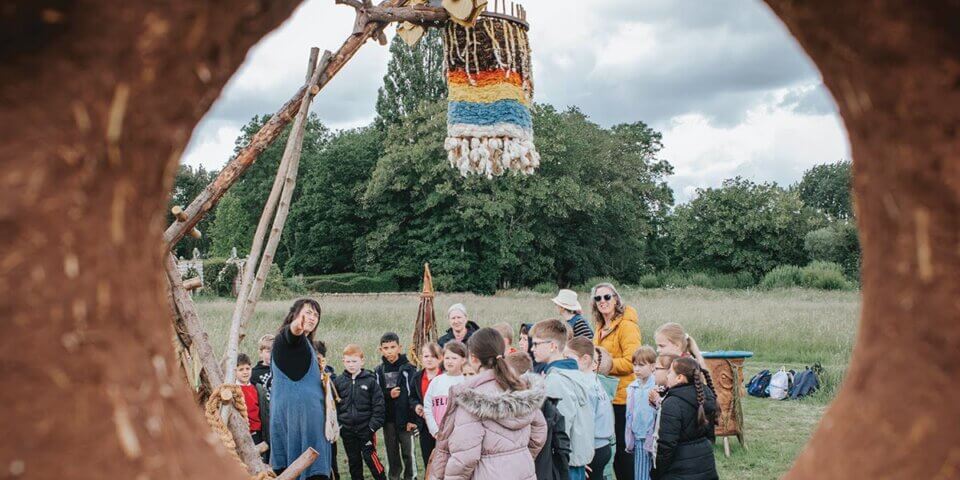
Learning Through Play: Riverside School and The Golden Valley Sundial
There is something special about seeing an artwork come alive through play. We loved seeing the Riverside School…

Golden Valley Molecules at No.1 Station Approach
Earlier this year, Meadow Arts installed a new public artwork by artist Cordelia Cembrowicz in the heart of…

New International Residency Exchange Partnership
Meadow Arts is thrilled to announce a new international partnership with CVAN England, CVAN West Midland with BBK Bayern…
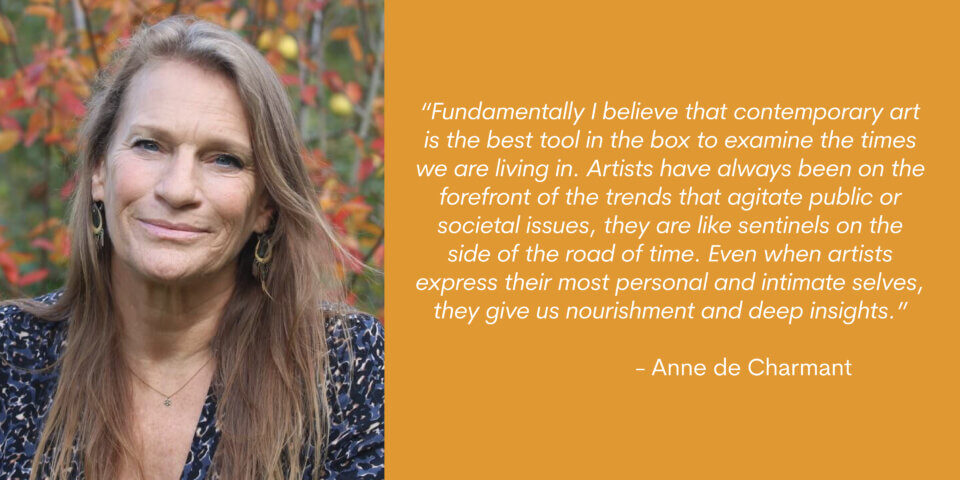
Five Minutes With: Anne de Charmant
In our short series Five Minutes With, we’ve been shining a light on the people who help bring Meadow…
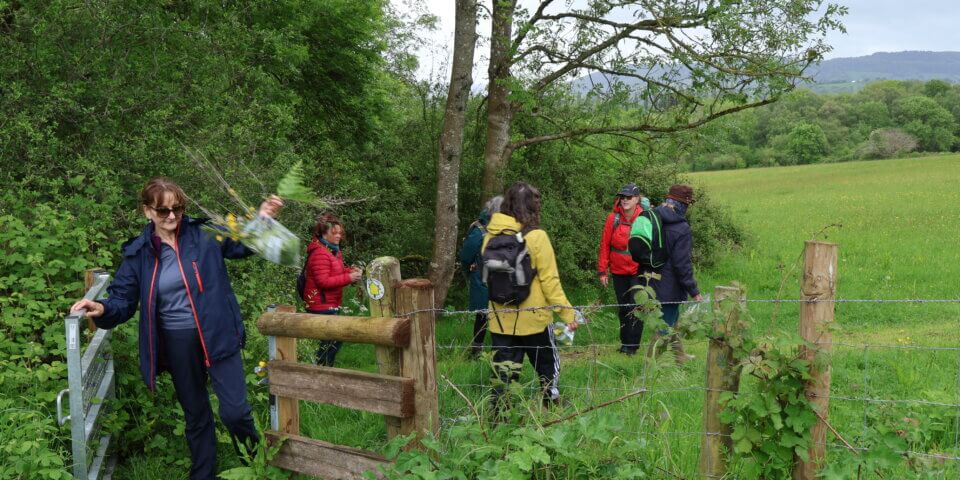
Our Place Golden Valley: Make Your Way Wednesdays
Over the past few weeks, we’ve been walking, looking and making together in the Golden Valley as part…