Latest News
Five Minutes With: Grace Emily Manning on The Golden Valley Sundial Project
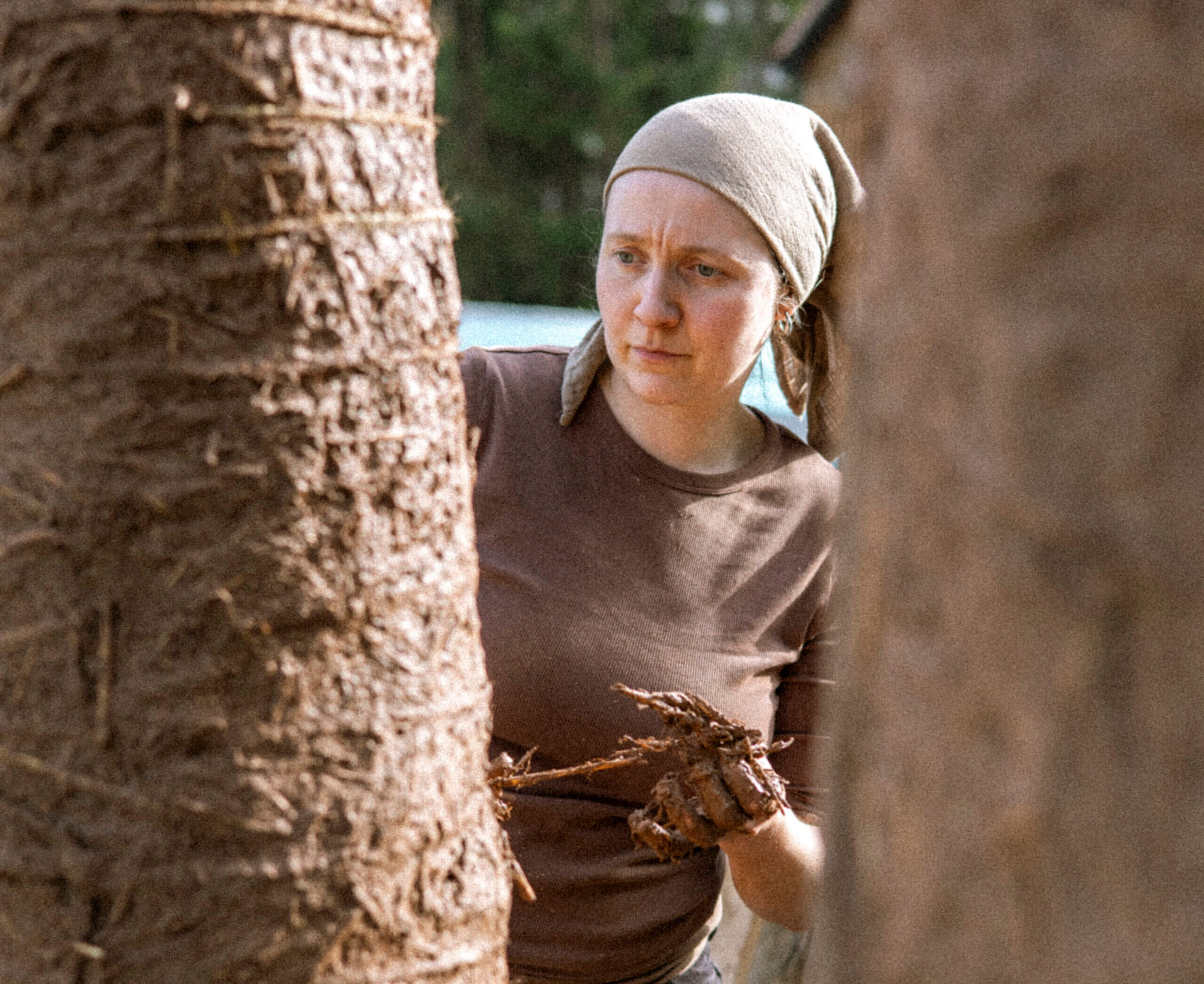
In our short series Five Minutes With, we’ve been shining a light on the people who help bring Meadow Arts’ vision to life. From dedicated team members to our brilliant Trustees and the artists we work with, we’re taking a closer look at the individuals who make everything we do possible.
In this episode, Clare Purcell, Executive Director at Meadow Arts, speaks to artist Grace Emily Manning about their artwork The Golden Valley Sundial, made in collaboration with Chris Poolman. This large-scale, interactive artwork was created with communities across the Golden Valley, as part of the Our Place Golden Valley project. Read on to learn about Grace’s wonderful ideas come alive through fostering connection and collaboration.
The more different people I work with, different ages, backgrounds, abilities and experiences, the less interested I am in ideas of who is or isn’t an ‘artist’. Give people materials, a story, a comfortable space and some freedom, and something happens.
Grace Emily Manning
Grace Emily Manning is a site-specific, eco-focused artist who blends fieldwork with folklore, fantasy, and sculpture/animation/performance. She grew up in the London suburbs, on the border of Kent along the Thames Estuary and creates projects that respond directly to landscape and place, drawing inspiration from the materials of each site. This practice has led her on a journey into nature-based materialism; making natural dyes, inks, pigments, and sculptures from locally sourced materials. Her work explores environmental themes and speculative sci-fi ideas for futures where humans live in true collaboration with nature.
Grace regularly works with communities to co-create large-scale public artworks across the UK, deepening her relationship with this island, its people, and its natural world. In a recent commission from Meadow Arts, called OUR Place Golden Valley, Grace worked alongside co-collaborator Chris Poolman (pictured below).
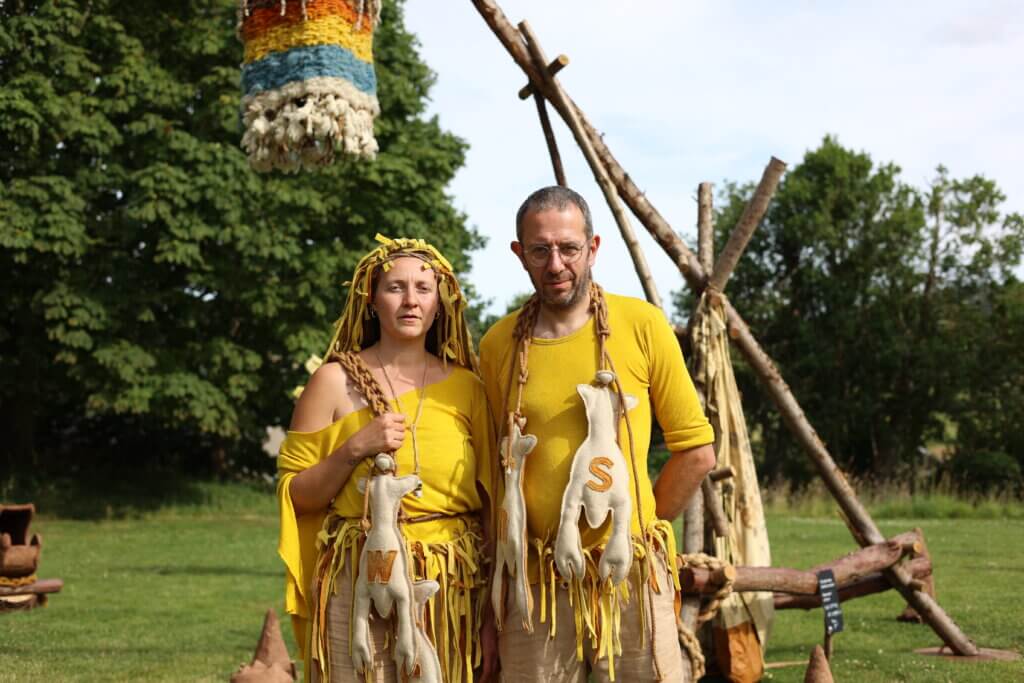
Photographer, Tegen Kimbley.
Clare: Your projects always start with fieldwork in a specific landscape for example, the Golden Valley, Cerne Abbas, Padstow. What does the research phase for these place-based projects look like for you, and is there usually a moment when a place starts turning into a story or a character?
Grace: They’re very visceral experiences. Wading through strange intertidal spaces pulling plastic out of mud, night walks by red head torch across moors looking for stone circles, bobbing for apples in small rock pools on cliff edges; slopping Wye algae into Tupperware boxes off a canoe; picking gorse flowers in driving rain at the top of a steep chalk hill.
But the research also happens in second-hand bookshops, local history archives and old photographs. I’m on apps identifying plants and bird sounds, following local Facebook groups campaigning to save wildlife, talking to people in pubs about the lead up to May Day. I love that search for connections – gradually mapping and understanding a place through lots of different kinds of knowledge.
I think the story actually starts straight away. I can feel the spirit of a place quite instinctively, but then the fieldwork gives that feeling roots. You start to understand its characters and the stories that have happened there, and the wildlife becomes part of that story too. Finding an ancient site, a spring or a well can feel like tuning into a current that is already there.
Collaboration is really important to that. Working with organisations like Dorset National Landscape or Beach Guardian brings another layer of knowledge and responsibility. As much as I’m interested in folklore and imagination, understanding the ecology of a place – what is happening to that land, what needs protecting and what needs to change – becomes incredibly important. The imagined story and the natural history aren’t really separate for me. They start feeding each other.

Clare: Interestingly, you trained in Experimental Animation and Performance Design rather than fine art. How did that background shape your approach and the way you respond to landscape and place?
Grace: Back in 2011 at Central Saint Martins, site-specific performance was one of the first projects on my course. It was the first time I’d really encountered that phrase: learn about a place, then create something specifically for that place. That was before the environmental side of my work became so vital to me, but looking back it really established a way of working that I’ve never left.
During that BA I also worked closely with an author for the first time, Sita Brahmachari, responding to her book and the landscape within it. As a performance designer, analysing and interpreting a text, story or song and then translating it into material, space, image or action is part of your toolkit. I love that process.
Experimental Animation then gave me permission to stretch what a story could actually be and how it could be told. During my Masters I became much more interested in which stories I wanted to tell, and that’s where this more fine-tuned method of reading a landscape began to form.
Now I think I approach a landscape almost as I might once have approached a text. I’m looking for characters, histories, materials, tensions, rhythms, things that have disappeared and things that are emerging. Except the text is alive – it might be a plant, a local story, a piece of plastic in the mud, an old photograph, a bird call or a conversation with somebody who has lived there all their life.
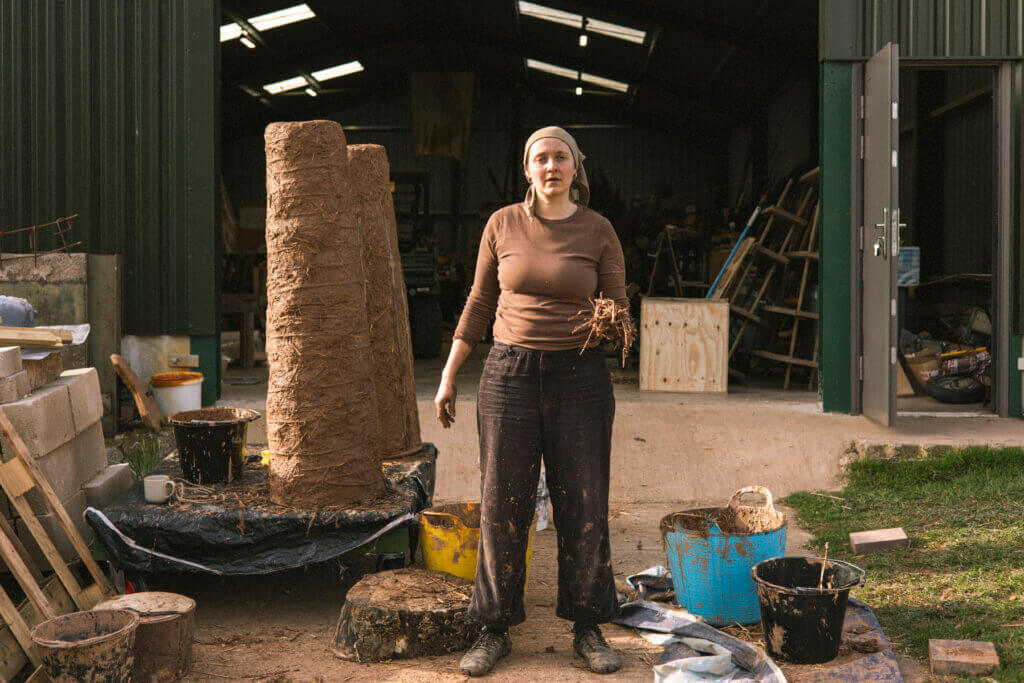
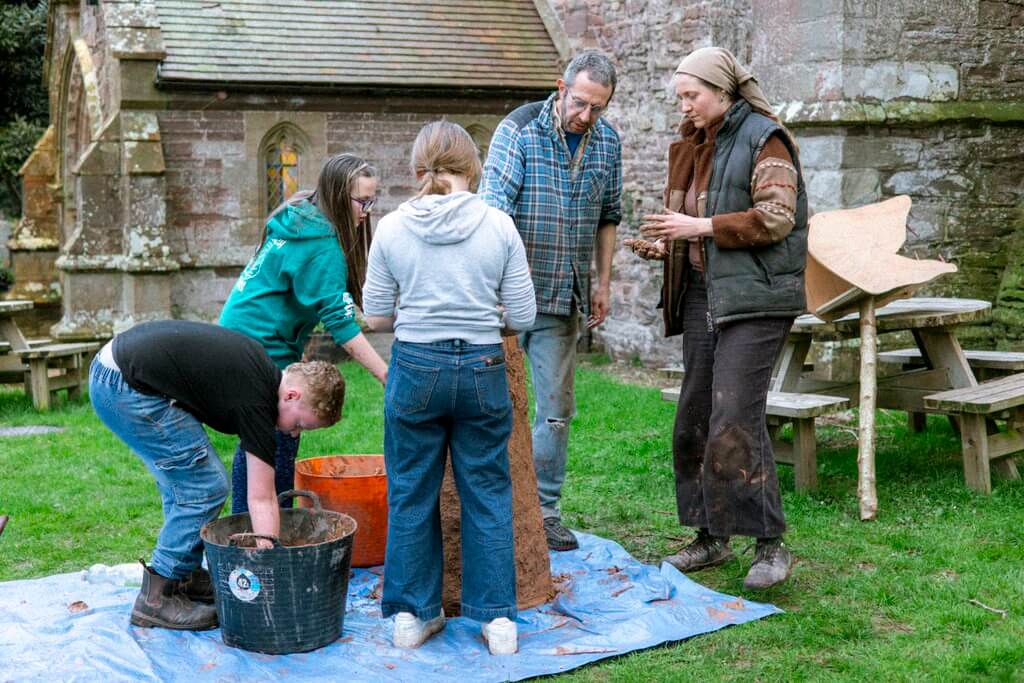
Clare: Your GEM Eco Studio is framed around natural dyes, bioplastics, and reclaimed materials, which you used so evidently in co-creating the Golden Valley Sundial with fellow artist Chris Poolman and the participants at Peterchurch Youth Group. Can you tell us more about the joys of that wonderful 12-piece cob sundial, and how it ended up as an interactive field game?
Grace: The game aspect really came from working with Peterchurch Youth Group and paying attention to how our sessions fitted into their day. They’d just finished school and part of their evening was always spent going over the road to the playing field. So, it became a bit of, ‘if you can’t beat ’em, join ’em!’
We wanted everybody involved to be able to find a way into the project. If drawing, printing, sculpting or writing wasn’t attractive to someone, maybe running around a field was. It was about playing to people’s strengths rather than deciding there was one correct way to participate. That eventually became the Sundial Games, with the twelve cob sculptures becoming part artwork, part playing field.
Working with Chris is a joy because we both get genuinely excited by things like copious amounts of pinecones, collecting conkers, fleeces, harvesting materials, digging holes, or getting a text from a tree surgeon saying we can have the redwood! He also brings an incredible amount of experience working with communities, so we bounce off one another very naturally. And there’s a shared level of ambition which drives things – that’s when it gets exciting, and I think people pick up on that energy.
Then there were all these quieter things. Working in a near thousand-year-old church carries an ancient energy, alongside the completely contemporary stories of the young people; the jumper someone’s gran bought them three sizes too big, or how strongly they felt about an old shed at school being removed because of the history held in it. Their knowledge of animals and nature, what each person cared about, and the way they made us laugh without even trying.
Personally, there was another joy too – finding a greater sense of belonging in rural spaces myself. Growing dye plants, digging clay and making cob sculptures in Herefordshire feels a long way from the suburban streets of Dartford where I grew up. The land, the materials and everyone’s hands in the cob together made the whole thing feel very alive.
Clare: Much of your work takes folklore and myth to explore ecological crises such as plastic pollution, lost wetlands and species decline. Do you see the fantasy elements as a way to make hard truths easier to sit with, or as something else entirely?
Grace: My work around Swanscombe Marshes in Northwest Kent is a good example. It’s an incredibly layered place. I’ve seen some of the most enormous concentrations of plastic pollution I’ve ever encountered there, but within that same landscape are endangered insects, rare birdlife and extraordinary habitats that have rewilded across post-industrial land – an insect ‘rainforest’. All those realities coexist.
I’m naturally quite solutions based, adaptable and future thinking, but I’m also highly sensitive and emotional and would happily live in a warren of rabbits! So, although I do sit with the heartbreak of ecological loss, imagination and creativity are how I proactively apply hope.
I want to make change – sometimes that’s very tangible like developing materials that are better for the earth, working with natural dyes or using what a landscape can provide responsibly, abundantly. But fantasy allows me to explore other ways of being and living. It becomes an offering – what else could our relationship with this place look like?
When that imagination is grounded in a very material, land-led practice, I think it can become part of healing rather than an escape from reality. That’s my bit of the work, because it’s what I’m good at. Then I collaborate with scientists, rangers, conservationists, beach cleaners and communities who bring completely different forms of knowledge. Collectively, we can shape something much richer.
Nature is extraordinarily good at finding a way through. Increasingly I think the question is whether humans can learn to do the same – and understand that ecological loss is our loss too.

Photographer, Tegen Kimbley.
Clare: You’ve worked with communities and schools a lot, from the Birmingham Allotment Project to Peterchurch Youth Group at the HUB in St Peter’s Church. Are there any moments from those collaborations that changed, or helped to shift, how you think about your own practice?
Grace: Definitely. I think it’s the diversity of people I’ve had the chance to work with that has shifted me most.
Working with neurodiverse teenagers, for example, continually reminds me that art is one of the most natural things we can do. Making, imagining, playing, building worlds, expressing something that might be difficult to put into words, these aren’t specialist activities – they’re incredibly human ones. Seeing that gives me a huge sense of purpose in my own practice too.
Working with refugee groups has made me think a lot about how lucky I am to have a creative practice and to have built a life around it. It’s taken sacrifice, risk-taking and a lot of uncertainty around income and security, but I still get to express my soul and imagination through what I do. And really, shouldn’t everybody get that chance?
I’ve also realised over the years that creating the space for that to happen is just as much a part of my practice as drawing, sculpting, making connections or having a particular wild idea. I’ve had a café, I’ve hosted spaces in different ways, and I genuinely love making people feel comfortable and welcome. I think I’ve carried that into my practice without necessarily realising it at first.
It’s made me think differently about what my skills as an artist actually are. Yes, there are the making skills and my own imagination, but there’s also hosting a space, talking to people, noticing when somebody needs a different way in, putting materials into someone’s hands and giving them enough freedom to make something their own.
The more different people I work with, different ages, backgrounds, abilities and experiences, the less interested I am in ideas of who is or isn’t an ‘artist’. Give people materials, a story, a comfortable space and some freedom, and something happens.
That continually brings me back to why I make things in the first place, and why creating the conditions for other people to express their own imaginations has become just as important to me.
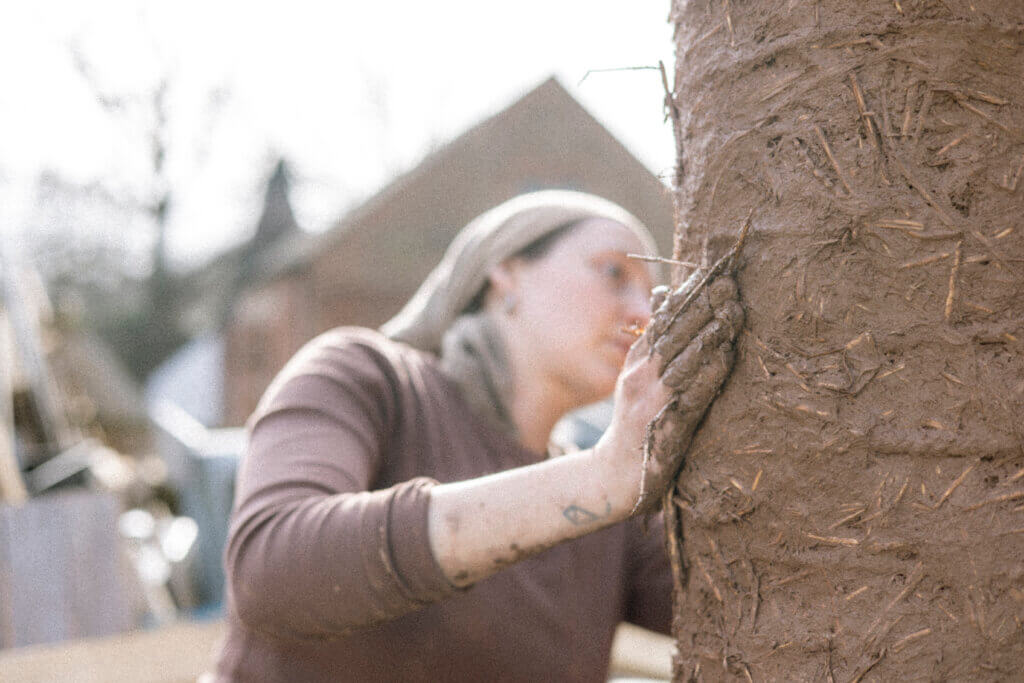
Commissioned by Meadow Arts as part of Our Place Golden Valley, the project celebrates creativity, local knowledge and community collaboration in rural Herefordshire.
Our Place Golden Valley is a Meadow Arts project. It is part of the Our Place Herefordshire programme funded by the National Lottery through Arts Council England, with match funding from Herefordshire Council and Hereford City Council.

More from Meadow Arts
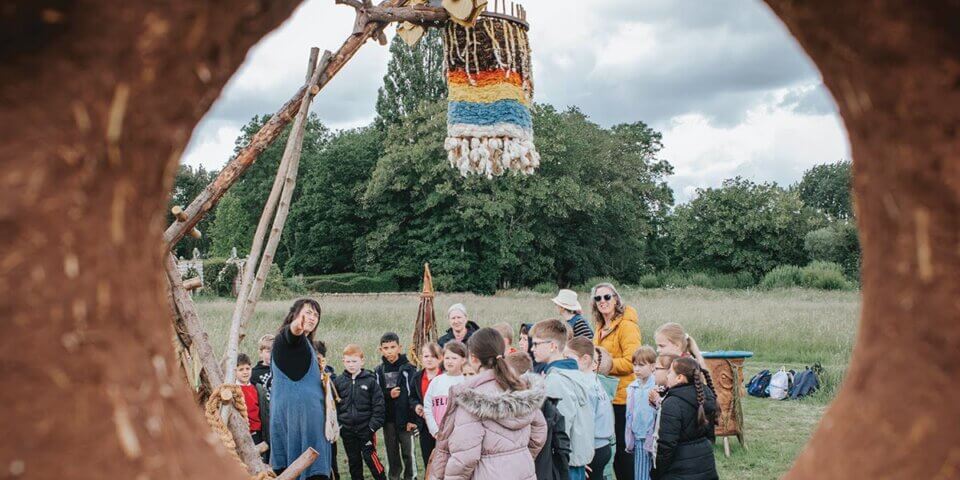
Learning Through Play: Riverside School and The Golden Valley Sundial
There is something special about seeing an artwork come alive through play. We loved seeing the Riverside School…

Golden Valley Molecules at No.1 Station Approach
Earlier this year, Meadow Arts installed a new public artwork by artist Cordelia Cembrowicz in the heart of…

New International Residency Exchange Partnership
Meadow Arts is thrilled to announce a new international partnership with CVAN England, CVAN West Midland with BBK Bayern…
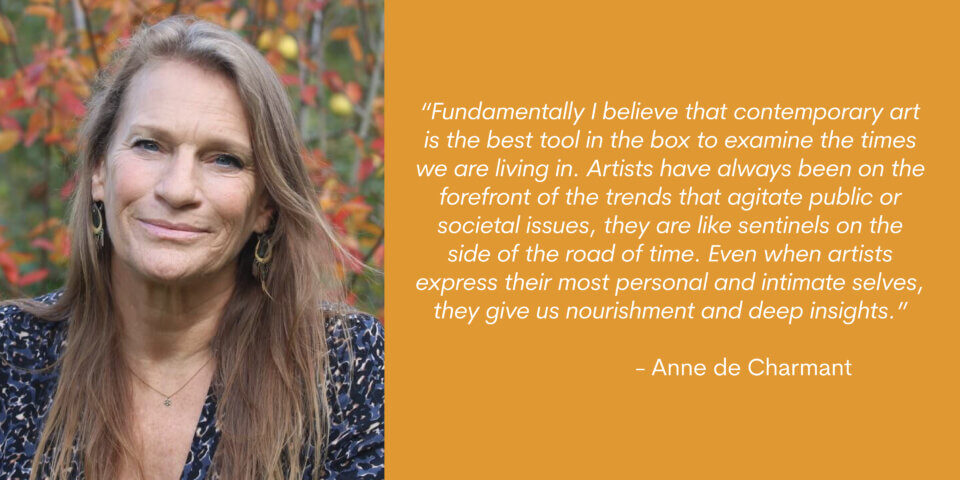
Five Minutes With: Anne de Charmant
In our short series Five Minutes With, we’ve been shining a light on the people who help bring Meadow…
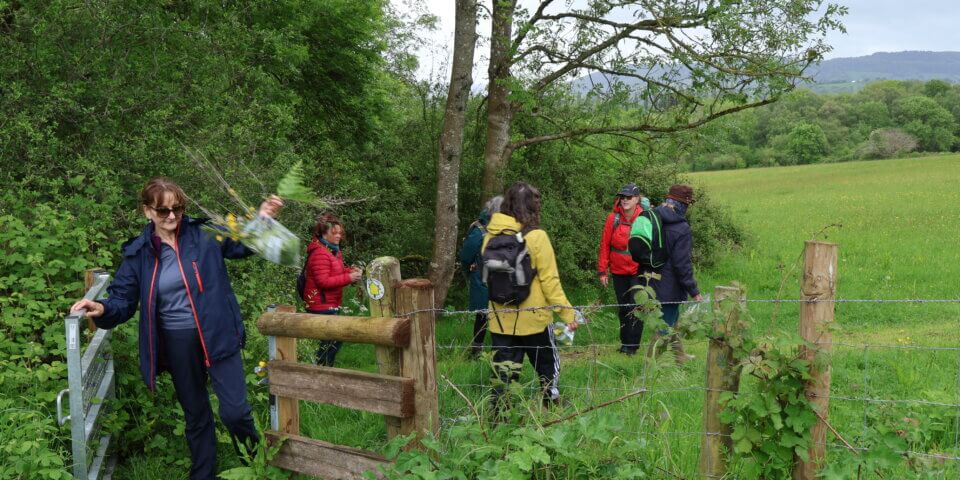
Our Place Golden Valley: Make Your Way Wednesdays
Over the past few weeks, we’ve been walking, looking and making together in the Golden Valley as part…

Celebrating 25 Years of Meadow Arts at Hay Castle
This year marks a very special milestone for Meadow Arts as we celebrate 25 years of bringing contemporary…