Latest News
Baroque Sprawl: A Q&A with artist Laura White
In this Q&A, curator Anne de Charmant and artist Laura White discuss White’s new public artwork, “Baroque Sprawl” for No.1 Station Approach in Hereford. This piece blends everyday materials with high art, reflecting White’s recent experiences in Rome and her fascination with the Baroque. Through their conversation, the pair explore the inspirations, materials, and artistic processes behind this significant work.
Anne: Can you briefly tell me about the commission for No.1 Station Approach in Hereford?
Laura: It’s a two-part wall piece on each end of a hall of residence building in Hereford. One end is a sort of relief sculpture, which is made from scaffolding fabric on a large metal frame. And the other end of the building has a large poster, which is of Bernini’s Daphne and Apollo sculpture, of which the sculpture [on the other end] kind of works from and mimics in some way.
I have recently returned from an Ampersand Foundation Fellowship at the British School in Rome. I was there for nine months and when I was there, the two things I was mostly engaged with were food and the Baroque. And I always quite like the very every day with the very high art and how these things collide.
Anne: One of the great masters of the Baroque that particularly marked you is the sculptor, Bernini, why did you choose this particular sculpture as a context for this commission?
Laura: Bernini’s sculpture of Daphne and Apollo is extraordinary, but it’s really about the story of Daphne, who is a nymph, and Apollo who is obsessed with her beauty and chases her and wants to possess her.
But she’s not interested in men. She’s never been interested in men. She lives in the woods. She had a great time. And she’s running away, trying to escape from Apollo. So, she calls on her father, who’s the god of the rivers, to do something and he transforms her into a tree, into a laurel. Bernini’s sculpture captures that moment, when she is turning into the laurel, and like you say, where the hand of Apollo grabs her side, it doesn’t embed in the skin, it’s hard because she’s turning into a trunk of wood, and so there’s no imprint, and she’s escaped, and Bernini’s sculpture is capturing that moment.
I also like the connection to nature, particularly in relation to Hereford. The end of the building where I’ve mounted this big poster, an image of this Bernini sculpture, Daphne’s flowing out of Hereford into this landscape all around it. I think it’s really important to look at artists like Bernini, and the Baroque, to think about what that means right now. My time in Rome and being fascinated by Bernini, finding the right sculpture for this commission in relation to Hereford. It’s come together really nicely for those reasons.
Anne: The materials that you use are rarely what you’d call sculptor’s materials. I love the idea that for this piece you’ve chosen materials that are very ordinary, scaffolding sheeting for example. The Bernini sculpture is made of this unbelievably pure and beautiful white marble and looking at the luminosity of this scaffolding sheeting it’s got some of the same qualities, doesn’t it?
Laura: It does, it has this slightly reflective quality. And what’s really interesting about this material is that it totally suits being outside. It’s the language of construction and spaces that have been built and developed, which makes it very suitable to the location. But it’s also this amazing material that you can form and fold and make shapes out of and to use it as a sculptural material has so much potential. I can sort of make pleats, ruche it and gather it using the bungees that are used to actually tie scaffolding sheeting to the scaffolding. So, all the materials are of that language, but they will be taken to a different place, to the Baroque, to something that’s about high art and a particular Bernini sculpture.
Anne: I think the nature of the material itself is going to surprise a lot of people, because in your manipulations, you completely change it. Nobody’s really tried to do what you’ve done before.
Laura: Yeah. Well hopefully, I haven’t actually seen anybody, and I’m sure there’s someone out there who’s been making sculptural stuff out of this material. But what’s amazing about it, it really holds its shape. I initially bought a silk parachute, thinking this would be the material. Because I liked the fact that it was quite airborne, and this idea that this Bernini thing was about making figures seem quite airborne.
But the fabric wasn’t of the language of that building and the scaffolding so that’s why I was drawn to this material, but also, it was very floppy, whereas this has got quite a structure to it, and you can really build it up, because of the nature of it being quite strong. So yeah, I think it’s a good material.
Anne: How do you feel about people seeing the work from their cars as they drive past?
Laura: I love the fact so many people will see it, you know, that’s kind of a lovely position to be in as an artist, to know that whether you like it or not, you’re going to see this thing when you’re sitting at the traffic lights.
Although it’s not a piece of work that you’ll understand just from a distance, it’ll pull you in, and hopefully, the audience will go up close to it and look up at it, and I want that. Because it changes a lot when you get up close to it, it’s a different type of work.
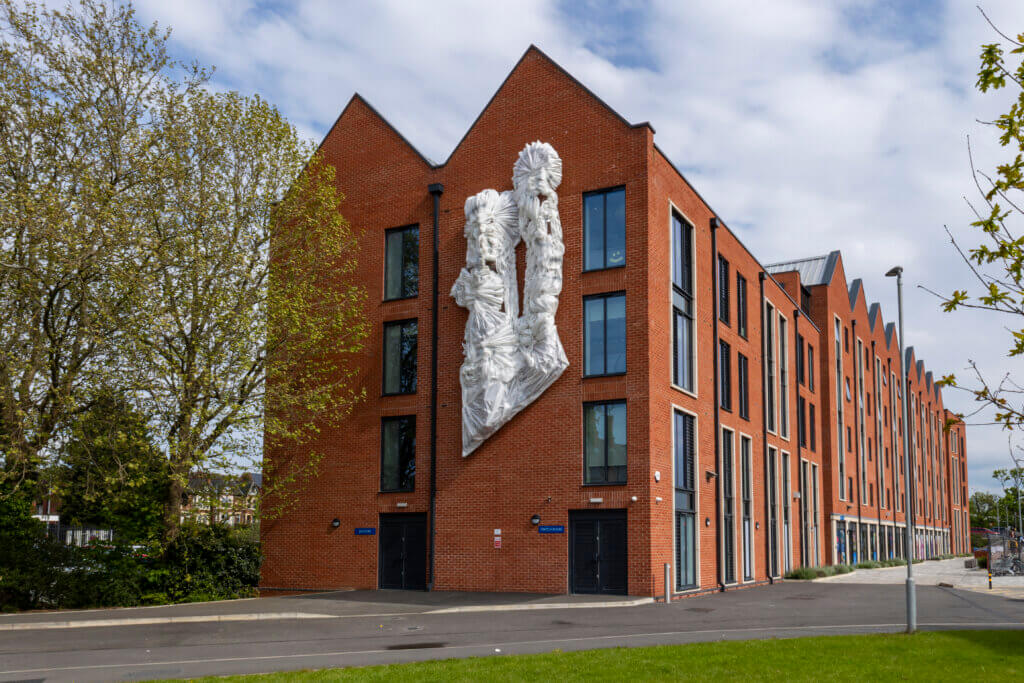

Laura White, Baroque Sprawl (2024). Scaffolding sheeting, bungees and aluminium frame (400cm x 950cm x 70cm). Images courtesy of Meadow Arts. Photographer, Tegen Kimbley.
A Meadow Arts and Hereford College of Arts Commission for No.1 Station Approach, Hereford.
Baroque Sprawl is the third bold commission of public artwork for No.1 Station Approach. It is one of fifteen projects launched in the city thanks to the support of Stronger Hereford, that aims to make the city greener, fairer, creative, digital and more connected. With support from HM Government’s Towns Fund.

More from Meadow Arts

OttM Diary entry: Learning to Make the Work
By Andy J Harper We are delighted to be part of Ode to the Midlands (OttM), a major…
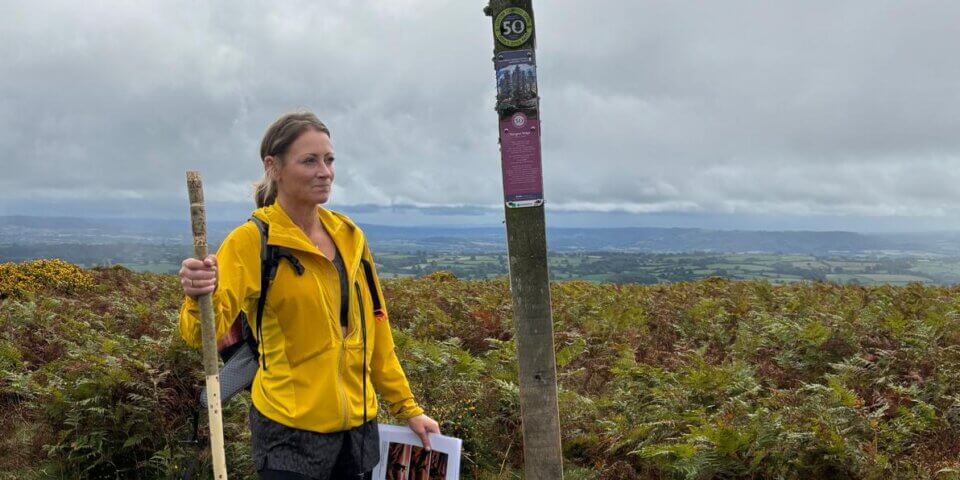
BorderLands Walking Series: Hergest Ridge with Caroline Allen
On 13 September, artist-curator Caroline Allen led a walk around Hergest Ridge, for our BorderLands Walking Series. Her…
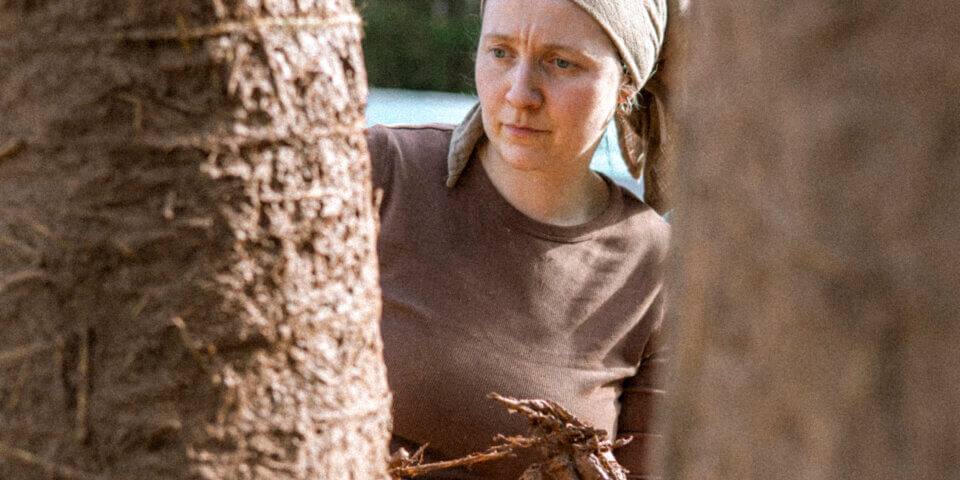
Five Minutes With: Grace Emily Manning on The Golden Valley Sundial Project
In our short series Five Minutes With, we’ve been shining a light on the people who help bring Meadow…
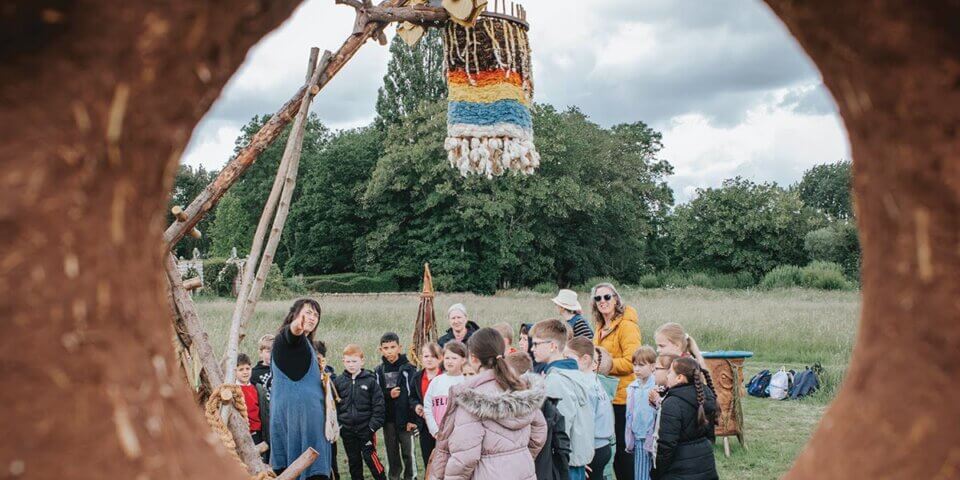
Learning Through Play: Riverside School and The Golden Valley Sundial
There is something special about seeing an artwork come alive through play. We loved seeing the Riverside School…

Golden Valley Molecules at No.1 Station Approach
Earlier this year, Meadow Arts installed a new public artwork by artist Cordelia Cembrowicz in the heart of…

New International Residency Exchange Partnership
Meadow Arts is thrilled to announce a new international partnership with CVAN England, CVAN West Midland with BBK Bayern…