Latest News
Interview with Lothar Götz

If you visit Hereford between now and April, you will see some very colourful artworks next to the Railway Station. No.1 Station Approach, Hereford College of Arts (HCA) and NMiTE’s new student accommodation, features two vibrant geometric artworks on each side of the building, as well as a number of dazzling flags by artist Lothar Götz.
The artworks mark the start of a new cultural gateway to Hereford, welcoming visitors and enriching residents’ experience of the city. The No. 1 Station Approach installation is one of fourteen projects that have been made possible thanks to a successful £22.4million funding bid to the Stronger Towns Fund. The project is a partnership between Meadow Arts and Hereford College of Arts.
Annabel, our Marketing and Communications Manager recently chatted to Lothar about his work and how he hopes the artworks are perceived in Hereford.
Your commission for Towner Eastbourne has been incredibly successful (and it’s fantastic to hear it will be up for a few more years!) How do you approach working on public sites and buildings?
With Towner, there were various factors – the building itself has quite striking architecture, then it’s in the middle of town in quite a prominent location. The Towner is then surrounded by lots of buildings for leisure and tourism and is in a city, Eastbourne, which had a reputation of being a place for retirement.
I didn’t know the building or Eastbourne [previously]. To do something on that scale outside is, of course, [site] specific because it will affect and play with the surroundings so you can’t ignore it. After they selected me, I went down and fine-tuned [the design] to really see the building. I stayed on a mini residency for a few days and worked on it.
For me a site visit is important to get a feeling for it, not just from a photo. Every location has its own character. If you are in a seaside town you hear the seagulls… on a busy road you hear tons of traffic.
One of the questions that mainly popped up from journalists about the project was ‘Did you get inspired by the deckchairs?’ I didn’t look at any deckchairs! Deckchairs didn’t play into it at all, apart from the fact that I could smell the sea air. A site visit is an intensive process.
I had a feeling the press did expect an outcry from locals. That didn’t happen. The response from the majority, for all age groups and really diverse groups [has been] extremely positive.
I imagine there will be an outcry when it’s removed!
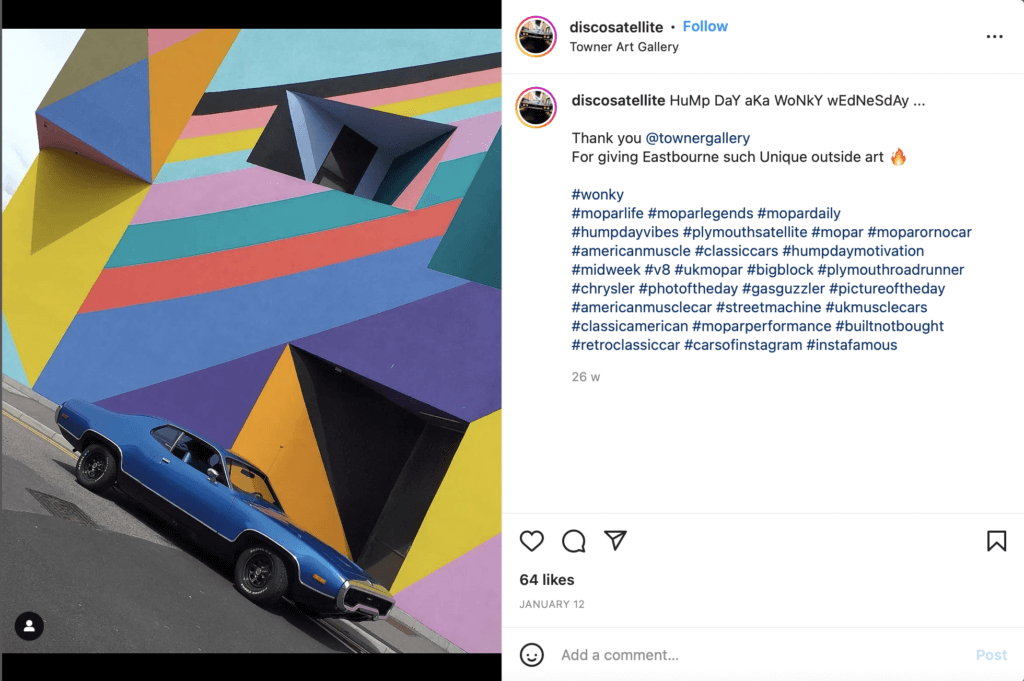
The Director of Towner has recently said that it’s becoming a bit problematic now as people really want to keep it but it was meant to be a temporary installation. It’s becoming a landmark. They only wanted it for a year, it’s now already extended to 5 years. I think it has been successful as a public art piece for what is has done for the town. I think it has helped Eastbourne to reinvent itself. Where it was most pictured and reviewed was in travel magazines. I’ve been interested in the responses from groups, not all into art. One of the most unexpected responses was that there are lots of guys going to Towner to photograph their really flashy cars in front of the building. I think what they’re looking for are reflections in the windows. It was something I was surprised by. There have also been residents who [have] said: ‘We brightened up our flat and repainted it Lothar Götz colours!’ and then sent a photo.
How did you go about designing your work for the space at No. 1 Station Approach?
[On the building itself] there are two prepared places for artworks which were probably part of the planning permission. The architects were planning for artworks on the two gable ends. It was like responding to these restrictions. I had a similar approach to Towner. The location is in one of these typical nondescript areas you [see] when you arrive in a city. You come out of the station, there are mainly cars and most people probably think [about] how they can get quickly into the town centre. I wanted to make an eye-catching artwork.
What inspires you to create your unique, strong, beautiful artworks?
It’s quite a lot of things. In previous interviews I’ve talked a lot about architecture. I’m also inspired by wall paintings, lots of things that are often from my childhood. As a young student the Bauhaus was very important as well as the wider Modernist movement and their use of colour. Two artists who were important [were] Ellsworth Kelly and Carmen Herrera. Then I get inspired by lots of things from daily life. I’m always excited when flowers come out. I do believe that nature is fantastic. I don’t paint a landscape, but I think the way of looking at a landscape does inform my work.
I’ve lived in London now for more than 20 years. I really do love big cities because I love going around in the evening and seeing all the lights. I’ve always been obsessed with Piccadilly Circus because of the adverts and the buzzing of lights. I’m not doing it very often any longer, [but] I really enjoyed going clubbing for many years, and I do really like the lights in discos or in clubs. I’m a big fan of disco balls and all their glimmering light.

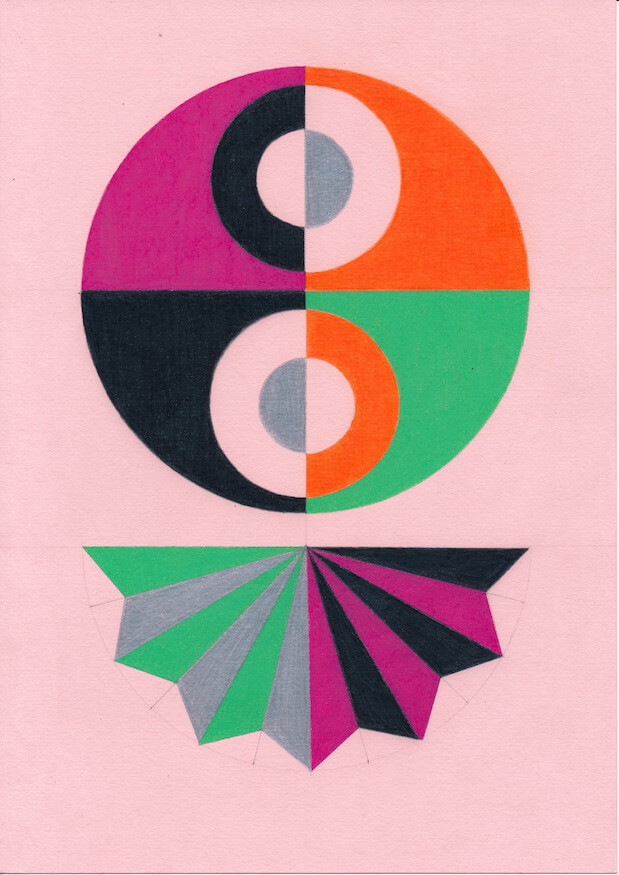
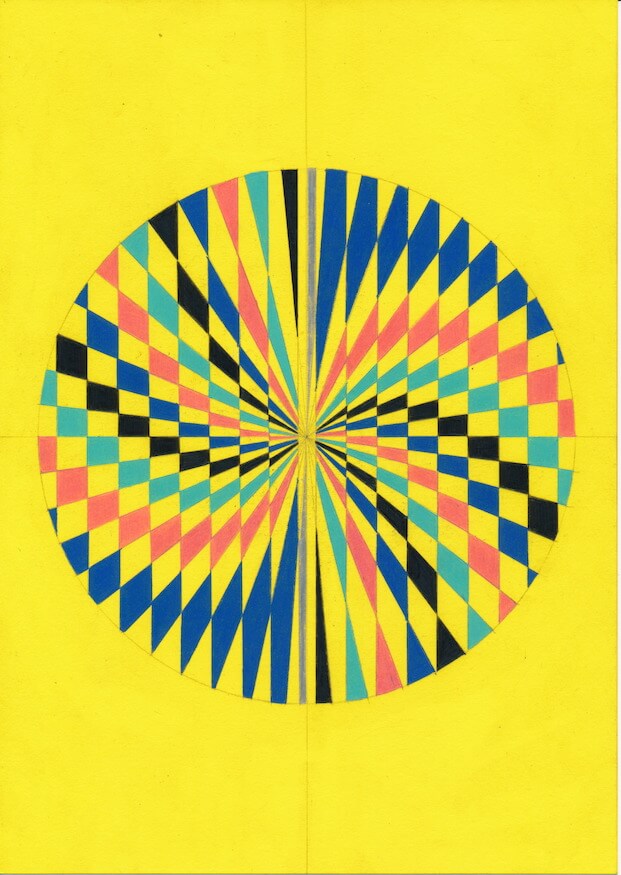
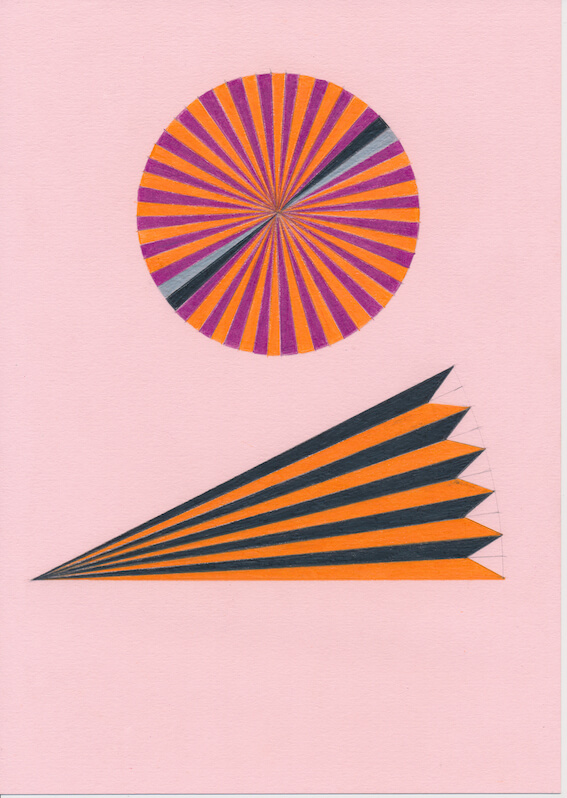
You’ve produced pencil sketches of the pieces for Hereford. You’ve said in past interviews that you love the openness of drawing and the fact that it’s not perfect. I felt that was unusual as the finished products are so geometric. How does physically drawing help the creative process?
Nowadays many people think, particularly in my case, that I sit in my studio at a computer and draw digitally, scan the building or the site in, and then it’s done. That’s not the way I work. I usually do a site visit, take photos. Then I might print them out and work in a very conventional way. I start drawing up ideas. It’s a physical experience encountering a site. There is a phase where I’m just testing out colours and ideas and then I often use a photo, tracing paper and make sketches on top of that. Lots of people, architects and designers are still doing that. It’s a phase that is a bit hidden nowadays because in a presentation it’s so often expected that everything is super slick and then everything kind of looks more perfect than in reality. That is exactly what I don’t like. I sometimes see images of mockups that are so perfect that I think what is the point? The final result can hardly top the aesthetic of the design model and it takes away the excitement the real thing.
One of the reasons why I like conventional drawing is that I think it’s an extremely open medium. It’s not about perfection. I think if you [draw] immediately on the computer it hides mistakes. I need the time it takes me to fill in a colour to work out the design. What I love about drawing is that it’s so accessible. It takes very little energy and it’s environmentally friendly! If you think about how much energy you use if you’re constantly on a computer… Everyone on a computer is also using a programme, so you’re basically a user of an Apple programme or a Microsoft programme. There is something in me that rejects that. I love pencils and I love paper.
Do you have a stand-out memory from childhood when you realised that you wanted to be an artist? I’ve noticed you’ve recently shared on Instagram some childhood drawings of you extending your childhood home.
Probably not one stand-out [memory]. It was pretty clear to me from a very young age that I wanted to do something art related. I didn’t grow up in a really arty family [but] parents were interested in art. I think there were lots of little moments when I realised the things I was interested in were art related. I was also very interested in architecture. I grew up in a small market town, a bit like Hereford. There was a time when there was lots of building work. I was obsessed with the building sites. We grew up in a very modest, small, detached house. I had all these ideas of extending it.
I hardly played with boys of my age. Playing with girls, which I did more, was seen by neighbours with a bit of a funny eye. They didn’t like it that much. So I escaped into a kind of fantasy world. I had my fantasy figures I played – a glamourous woman who was driving in a golden car and doing fabulous things; I was playing with dolls and building houses with Lego. It was a mixture of things I really loved. I grew up in a very religious Catholic environment. [Where I grew up is] this amazing Baroque Church which has an amazing Rococo ceiling painting of the four continents. I looked at it all the time. That might have been the first time I discovered the power of a wall painting, the power of art.
I was always interested in architecture and gardens, but it never occurred to me that I could be an architect because that would have been ‘real’ then. This was very much my route into art. At school I always loved drawing and painting. I always liked colour. When I think of colour and abstraction, I often think about having rows with my art teachers when I was quite young. I remember we had to paint a car and I chose a Volkswagen Beetle. I just drew the outline of the car (I love that shape) and then filled in that shape with bright blue. My teacher was outraged…I think of that as my first discussion in defence of abstraction.
I particularly admire the textiles that came out of the Bauhaus. Your works certainly lend themselves to practices like weaving and quilting, and for No. 1 Station Approach you will be creating a series of flags. Have you explored using textiles more in your work?
I have explored it less than I would like to. I love textiles as well. Recently I have made carpets, most recently for Petra Rinck Gallery in Dusseldorf. I’m a big fan of textiles from the Bauhaus as well, in particular Anni Albers and Gunta Stölzl. I’m always stopped because it’s so expensive. What I like is the domestic qualities. People often comment that I really should do quilting. But I don’t have the skills to do it myself, so you have to collaborate with people. In the Bauhaus a lot of designs came out of collaborations like with Josef and Anni Albers. That was very fruitful. They both batted ideas between one another.
What do flags mean to you and how do you hope they will be perceived?
I have something of a love/hate relationship with flags. There are moments where I love flags and moments where I don’t like them. One great memory I have was when I was nine years old [and visited] the Munich Olympic Games. I lived around 70 miles outside Munich. When you approached [the city] they had all these flags on the motorway in beautiful colours. The design and the colour scheme was amazing. The design was very abstract, very high quality 70s design I would say. It was iconic, very forwards looking. I think I was in ecstasy when I saw it! I can still remember it. I found it fantastic and it’s one of my most memorable moments from the whole Olympic Games.
I come from Bavaria and love the Bavarian flag. It has blue and white lozenge shapes. For me it’s the abstraction of the sky and of heaven. Without the crest of anything on it I think it’s a very beautiful flag. Not out of nationalism for Bavaria. I reference it in quite a lot of artworks of mine. For me it’s just the abstraction of when you look to a beautiful Summer sky…with white clouds.
I think many Germans of my generation have a kind of reservation to flags because they meant so much during Nazi Germany. A promenade of flags gives me the shivers. I could enjoy the flags when I was nine [visiting the Munich Olympics] as I was too young to be aware of what happened in Nazi Germany. For Hereford, we discussed that I don’t want a promenade of flags. For that location it has exactly that moment when you drive into a city, a bit like when my family drove into Munich as a child. I don’t like the political aspect of flags, holding the flag as a symbol of something – I’m a bit on edge with that. In Hereford its more of a kind of celebratory moment. With the war in Ukraine, suddenly flags became more prominent again. What I always like with flags is abstraction. There are a number of artists who have done flag projects, they have painted their flags. The yellow and blue of the Ukrainian flag is quite a beautiful abstract painting.
Flags in general can shift very quickly from something celebratory and patriotic. A bit like the British flag. There are moments it’s quite nice to see it – a street party – but it can twist quite quickly and you think, I don’t really like that anymore.

What impact and influence do you hope this project will have on the local community?
I do very much hope that it adds something that wasn’t there before. Sometimes I think it’s good to not dictate [what that could be] too much. You don’t know from which areas reactions might come. But I very much hope that it in some way enriches lives.
As an Associate Professor in Fine Art, how are you finding the last 2 years have affected the next generation of artists?
Life shrank to your computer screen and home. I do think that the students who had two full years in lockdown suffered a lot. There were probably also positive aspects where you could focus on your own things, or small scale, smaller works. The people who graduate this year who were in lockdown right from the beginning got so used to [lockdown], that it was hard work to get them out of that mindset again.
Photos: Oliver Cameron-Swan.
More from Meadow Arts

OttM Diary entry: Learning to Make the Work
By Andy J Harper We are delighted to be part of Ode to the Midlands (OttM), a major…
BorderLands Walking Series: Hergest Ridge with Caroline Allen
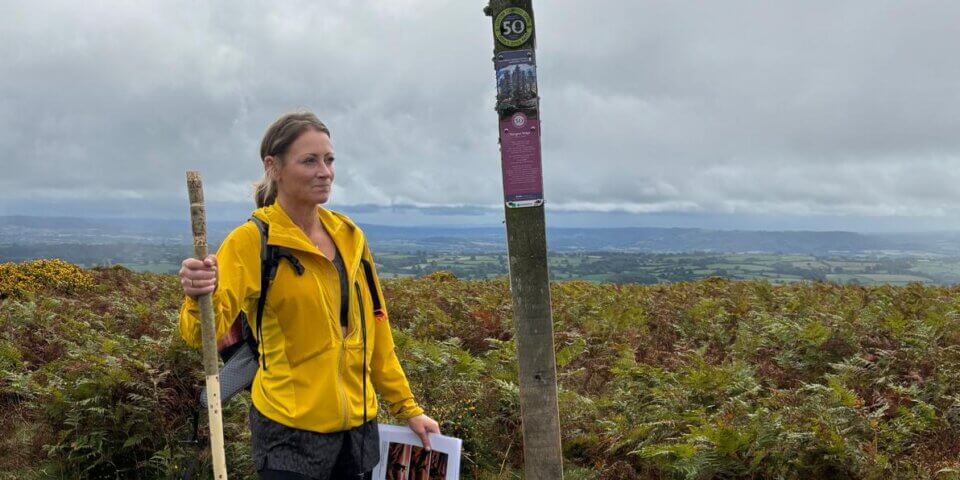
On 13 September, artist-curator Caroline Allen led a walk around Hergest Ridge, for our BorderLands Walking Series. Her…
Five Minutes With: Grace Emily Manning on The Golden Valley Sundial Project
In our short series Five Minutes With, we’ve been shining a light on the people who help bring Meadow…
Learning Through Play: Riverside School and The Golden Valley Sundial
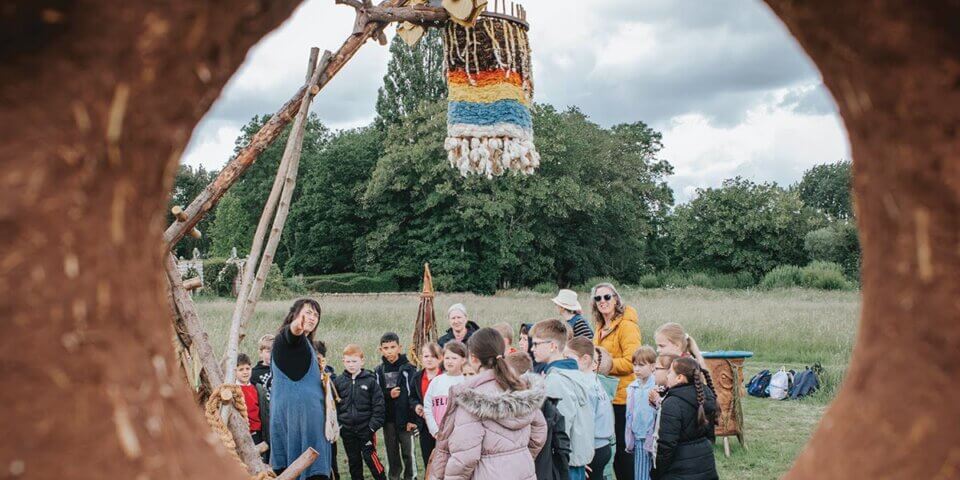
There is something special about seeing an artwork come alive through play. We loved seeing the Riverside School…

Golden Valley Molecules at No.1 Station Approach
Earlier this year, Meadow Arts installed a new public artwork by artist Cordelia Cembrowicz in the heart of…

New International Residency Exchange Partnership
Meadow Arts is thrilled to announce a new international partnership with CVAN England, CVAN West Midland with BBK Bayern…