Latest News
Beyond Natural: Barbie in the Boudoir
by Anne de Charmant, Artistic Director
Curating and hanging Oliver Jones’ stunning large pastels in the beautiful interior of Berrington Hall was a treat. This is the part of my job I find most energising and fulfilling. To me, it’s about capturing and channelling all the threads: the artist’s intention, the way the ideas come together in the artworks themselves, in Oliver Jones’ case through shapes, tones and composition. Then looking around at the way a site works, at the genius of the place. In this case, what the Georgian rooms have to say, what they express of the people and the times, from the first occupant to how we read them now.
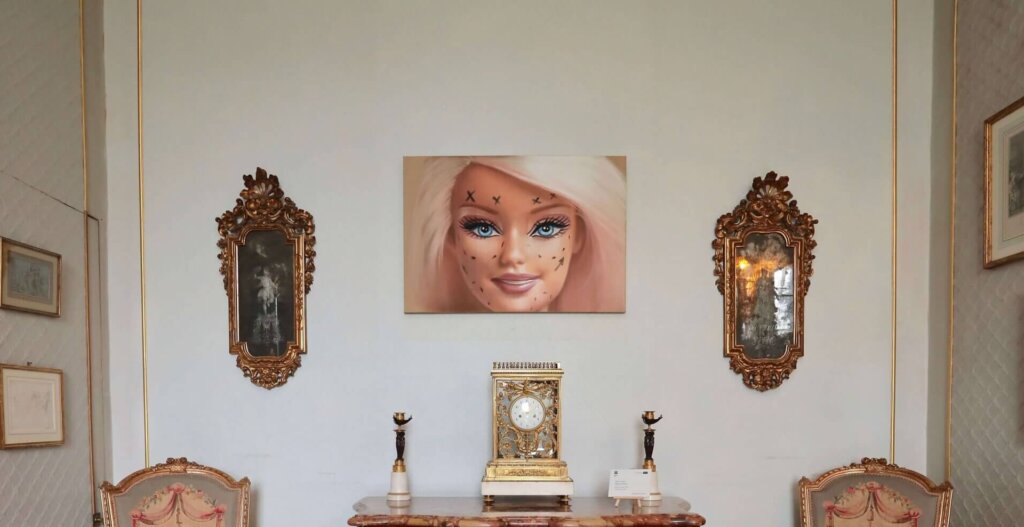
In fact, the first trigger for the project came in the small but perfectly formed Boudoir (or sulking room, from ‘bouder’ in French). Intensely feminine, the room has a half-vaulted, painted plaster fanned ceiling, resting on two delicate columns. The pinks, white and gold of the elaborate plasterwork are picked up in the furniture and the two elegant day dresses on mannequins. This is where the ladies of the house retired to sew, chat and while away the hours. In itself, the room encompasses what a lady should be; elegant, petite, delicate and seductive. It made me think of how these values endure – or not – in our times, bringing up societal ideas of conventions and expectations. Oliver Jones’ large pastel ‘portrait’ of a Barbie doll, titled Beyond Natural, imposed itself on me in that room.
His picture of the globally famous doll with, on her face, the marks of ‘plastic surgery to come’ is, on one level a brilliant visual pun, but on another, it is a deep critique of Western cultural values. Barbie is supposed to be the perfect woman, how could one improve on that? Also, she is materially fixed, exactly moulded and ‘printed’ in an almost infinite number of plastic units. Her ever-smiling face is an ideal of huge doughy blue eyes, tiny nose, large pouty pink lips and, of course, an abundance of coiffed blond hair. Who made her that way?
Barbie was created and designed by the male gaze, by corporate America, in a time of ideological strife during the Cold War. The suggestion that she isn’t so perfect after all and can be altered, is subversive in a political, ideological and racial sense, as it revisits what we see as relatively defunct historical ideology. The primary strength of the work though, is a social and psychological critique that brings up important issues of self-image and mental health.
Millions of girls, over several generations, grew up with this improbable and ultimately nefarious model of femininity. Barbies were, and maybe still are, given to girls teetering on the perilous edge of pre-puberty. One of the great strengths of Jones’ Barbie is that it concentrates on the face, but the body is aggressively present in our mind’s eye: impossibly long sexy legs, tiny flat tummy, minuscule waist and improbably generous, highly-held breasts. To the pre-adolescent girl, whom this toy is aimed at, it showed explicitly what her physical metamorphosis ‘should’ be, a road map for her body. What if she grows to be nothing like Barbie? Where does that leave the girl as a future woman? I remember having these dizzying interrogations myself, at an age when the world seemed to expect so much of me.
Barbies are constantly dressed and undressed as one important function of the toy is to perpetuate the commercial mechanism of buying an infinite wardrobe of tiny accessories and clothes; the game is to animate them and put them into play into the ‘ideal’ domestic or social situation.
Over time, there were black Barbies, red-heads, and Air Hostess outfits, typewriters and cars. And, of course, there was Ken, the crew-cut male mate. But the enduring one is the blonde and pink Barbie depicted by Jones, from a toy he bought in a charity shop. If one looks carefully, some of the paint in her make-up is chipped, an imperfection Jones carefully details in pastel, before applying the tell-tale sign language of the plastic surgery to come. What would a modified Barbie look like? More, less human or ‘Beyond Human’?
In its decoration, size and furniture, the Boudoir at Berrington also acts like a mould, a fold for a woman’s life. Generations of girls and ladies have sat there, by the sewing table, at the small writing desk, examining their aspect in the gilded mirror; learning to be women.
This post relates to a previous exhibition, visit the exhibition page for more information about Skin Deep at Berrington Hall.
More from Meadow Arts

Golden Valley Molecules at No.1 Station Approach
Earlier this year, Meadow Arts installed a new public artwork by artist Cordelia Cembrowicz in the heart of…

New International Residency Exchange Partnership
Meadow Arts is thrilled to announce a new international partnership with CVAN England, CVAN West Midland with BBK Bayern…
Five Minutes With: Anne de Charmant
In our short series Five Minutes With, we’ve been shining a light on the people who help bring Meadow…
Our Place Golden Valley: Make Your Way Wednesdays
Over the past few weeks, we’ve been walking, looking and making together in the Golden Valley as part…

Celebrating 25 Years of Meadow Arts at Hay Castle
This year marks a very special milestone for Meadow Arts as we celebrate 25 years of bringing contemporary…

Ode to the Midlands Commissioned Artists Announcement
We are delighted to be part of Ode to the Midlands (OttM) with CVAN West Midlands and CVAN…