
Cross-Stitch Through the Dirty Page of History
This artwork featured in BorderLands (2026).
A large part of Herefordshire -based artist Sally Payen’s work is about protest and its place within western democracy. One of her main inspirations was the historic women’s peace camp at Greenham Common, a military site with a long history of contested landscape in the 1980’s, near to where she grew up.
Here, the subject of the painting is the fence itself, made of the ubiquitous security weld mesh panels, as well as the reaction of the female campaigners to it. They attached crafted or knitted objects and banners, opposing a slow peaceful form of protest to the repressive boundary. In response, Sally painted the fence on the canvas by making crosses in a slow process of repetition, expressing her democratic right and personal memories in a decisively gendered action.
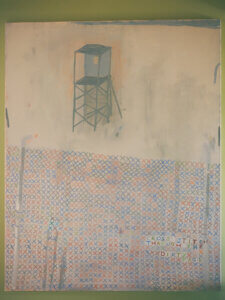
Image: Sally Paven, Cross-Stitch Through the Dirty Page of History, Oil on canvas. Installation view, BorderLands, Hay Castle, 2026. Image courtesy of Meadow Arts. Photographer, Finn Beales.
About the artist
Sally Payen
Born in Oxford UK. Payen attended Brighton Polytechnic (now Brighton University) for her painting degree, she attended the painting school of the RCA when it was housed in the V&A and her understandings became shaped by modernism and frequent visits to the Indian paintings in the V&A. Payen completed a doctorate at Brighton University in 2005 exploring ideas about time, space and embodiment in painting, supervised by Professor Michael Tucker, she remains influenced in equal parts by the western philosophy of Lyotard and eastern metaphysical views.
Building on her modernist painting roots Payen started to explore the push and pull of democracy from 2005. Her work has been discussed in terms of history painting and its relationship to conflict and more recently embodied action, erasure and exploration of a feminist mark making. Matt Price explores Payen’s use of the term mélos to understand her approach to painting in the making of a body of work about Greenham Common; ’Mélos is both curious and cryptic and stems from Payen’s interpretation of philosopher and theorist Jean-François Lyotard’s use of the word mélos to describe an aesthetic, poetic, musical – almost religious – experience in the stages before a story has been told and before we can reflect on its meanings… For the artist, the process of painting conveys a deep and emotional power that can be felt or understood before knowing or recounting ‘the story’ of Greenham Common. Just as a piece of music without words can capture and convey a profound mood, a moving emotional register, so too can paint’. From the publication and exhibition ‘The Fence and the Shadow’, 2017, MAC Birmingham.
Payen’s work is held in many collections including – Government Art Collection, The New Art Gallery Walsall, The Towner Collection, Royal College of Art, The John Feeney Collection, Wolverhampton Art Gallery, Annabel Birtles Collection, Minerva Collection, Jacob Mendolsolm Collection, Swindon Museum and Art Gallery, Hereford Museum and Art Gallery.